

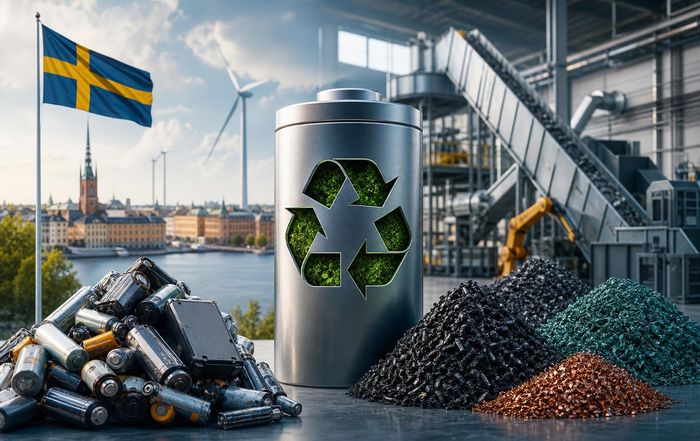
Sweden's Battery Recycling Businesses Face a Scale Challenge
Sweden has positioned itself at the heart of Europe's emerging battery economy. With Northvolt's gigafactories, strong automotive and industrial clusters, and ambitious climate policy, the country aims to be a major supplier of sustainable batteries to European and global markets. Yet as production ramps up and end-of-life batteries begin to return in volume, a critical bottleneck is emerging: scaling battery recycling from promising pilots to industrial systems that can handle hundreds of thousands of tonnes per year, profitably and safely. Swedish recyclers, automakers, and policymakers are discovering that building a circular battery value chain is far harder in practice than in strategy documents.
This scale challenge matters well beyond Scandinavia. The European Union's new Battery Regulation, in force since 2023, is reshaping how batteries are designed, produced, and recycled across the bloc. It mandates minimum levels of recycled content for key metals like lithium, nickel, and cobalt, and sets rising collection and recovery targets that will affect suppliers and manufacturers from Asia to North America. Sweden's experience is becoming an early test case for whether advanced economies can turn ambitious circular-economy plans into operational reality. For investors, manufacturers, and policymakers tracking the future of clean technology, the country's battery recycling sector offers an instructive mix of technical progress, policy pressure, and hard commercial constraints.
For people watching the intersection of business, technology, and the green transition, this is not only an environmental story; it is a markets and industrial-strategy story, closely tied to supply chains, capital flows, and new forms of regulation. It intersects with broader developments in global business and trade, sustainable industry policy, and the shifting balance of power in technology and manufacturing.
How Sweden Became a Battery Powerhouse
Sweden's prominence in the European battery debate is relatively recent. A decade ago, the country was better known for hydro and wind power than for electrochemistry. That changed with the founding of Northvolt in 2016, which set out to build large-scale, low-carbon battery production in Europe to reduce dependence on Asian suppliers. Northvolt's flagship plant in Skellefteå, together with its planned facilities in Gothenburg and other European locations, has attracted billions in investment and long-term supply agreements with automakers such as Volkswagen and Volvo Cars. The company has also made recycling central to its brand and business model, launching its Revolt program to recover metals from production scrap and end-of-life batteries.
Northvolt is not alone. A growing ecosystem of Swedish and Nordic firms is developing technologies for collection, disassembly, and materials recovery, often in collaboration with universities such as Chalmers University of Technology and KTH Royal Institute of Technology. The country benefits from relatively low-carbon electricity, strong engineering capabilities, and a policy environment that has long favored environmental innovation. Swedish authorities have aligned national strategies with broader European Union policy, particularly the EU Green Deal and the push for strategic autonomy in critical raw materials. The European Commission has explicitly highlighted battery recycling as a pillar of its circular economy agenda, and Sweden has sought to position itself as a preferred location for energy-intensive but climate-oriented industries.
At the same time, Sweden's industrial history in mining, metals, and heavy manufacturing gives it a base of expertise in handling complex material streams. Companies in the region have experience with smelting, refining, and chemical processing, which are central to modern battery recycling. This industrial heritage, combined with new cleantech investment, has created a sense that Sweden can become a European hub for both primary and secondary battery materials. For many observers, the country appears well placed to deliver on the EU's targets for recycled content and reduced dependency on imported raw materials, especially from China and the Democratic Republic of Congo.
Yet this optimistic narrative can obscure the practical realities of building a profitable recycling industry. While Sweden has several pilot and early-stage plants, the volumes being processed are still small compared with what will be required in the 2030s. Most of the batteries currently entering recycling streams are production scrap or relatively small consumer batteries, not the wave of large electric-vehicle packs that will arrive as today's EVs reach end of life. This temporal mismatch between investment decisions and feedstock availability is one of the core scale challenges facing the sector.
EU Rules Are Raising the Stakes for Recyclers
The regulatory backdrop is central to understanding why Sweden's recyclers are under pressure to scale. The EU Battery Regulation, which began applying in phases from 2023, replaces the older Battery Directive and significantly tightens requirements for producers and recyclers. It introduces mandatory recycled content for new industrial and electric-vehicle batteries: by 2031, for example, large batteries placed on the EU market must contain minimum percentages of recycled cobalt, lithium, and nickel. It also sets progressively higher collection and recovery targets, including stringent efficiency thresholds for how much of each metal must be recovered during recycling.
These rules effectively transform recycling from a voluntary or reputational exercise into a regulatory obligation. Battery manufacturers placing products on the EU market must demonstrate compliance through due diligence, documentation, and, eventually, digital "battery passports" that track composition and lifecycle data. This regulatory architecture is being shaped by EU institutions and agencies such as the European Environment Agency and is informed by research from organizations like the Joint Research Centre and the European Chemicals Agency. It is intended to support broader climate and resource-security goals, including those articulated by the International Energy Agency in its analyses of critical minerals and clean-energy transitions.
For Swedish firms, these obligations create both an opportunity and a burden. On one hand, companies that can offer high-efficiency, low-emission recycling services stand to benefit from growing demand, particularly as automakers and energy-storage providers seek to secure compliant supply chains. On the other hand, meeting EU recovery thresholds and documentation requirements increases capital and operating costs, especially at small scale. This is exacerbated by the fact that battery chemistries are diverse and evolving, which complicates process design and regulatory compliance.
The new regulation also tightens rules on extended producer responsibility, meaning that producers are ultimately responsible for collecting and recycling batteries. This shifts financial risk from municipalities and consumers to companies, and it encourages vertical integration or long-term partnerships across the battery value chain. In Sweden, where many industrial players are still defining their roles, the result is a fluid landscape of joint ventures, pilot collaborations, and competing business models. The regulatory clock, however, is ticking, and firms must plan now for the much larger volumes that will be regulated in the coming decade.
The Economics of Scale: Why Volume Matters So Much
At the core of Sweden's battery recycling challenge is a simple industrial reality: these processes are capital-intensive, technically complex, and highly sensitive to throughput. Whether a company uses pyrometallurgical smelting, hydrometallurgical leaching, or advanced direct-recycling methods, it must invest in specialized equipment, safety systems, and environmental controls. These fixed costs are easier to absorb when plants run near capacity, processing large and predictable volumes of feedstock. When volumes are low or volatile, unit costs rise, and profitability becomes fragile.
Swedish recyclers face a double bind. On one side, they need to build capacity ahead of the anticipated surge in end-of-life batteries, which will come as early waves of electric vehicles, grid-scale storage systems, and industrial batteries reach retirement. On the other side, the actual flow of batteries today is still modest. According to data and projections from organizations such as the International Council on Clean Transportation and the IEA, the bulk of EV batteries will not enter recycling streams until late in the 2020s and 2030s, given typical vehicle lifetimes and the possibility of second-life applications in stationary storage. This timing gap means that early recycling plants must either operate below capacity for years or rely heavily on production scrap and imported material.
Competition further complicates the picture. Large global players, including established metals and mining companies, are expanding into battery recycling, often leveraging existing smelters and refineries. Asian firms with experience in electronics recycling and battery manufacturing are also eyeing the European market. For Swedish startups, this means that access to feedstock is not guaranteed, even if domestic EV adoption continues to grow. Automakers and battery producers may choose recycling partners based on cost, technology, integration, and geopolitical considerations, not simply proximity.
Commodity price volatility adds another layer of uncertainty. Battery recycling economics are closely tied to the market prices of recovered materials such as nickel, cobalt, lithium, and copper. When prices are high, recovery can be lucrative; when they fall, margins shrink or disappear. Recent years have seen significant swings in lithium and nickel prices, influenced by supply expansions, demand fluctuations, and policy shifts in major producing countries. For investors evaluating Swedish recycling projects, these price cycles complicate forecasts and increase perceived risk, especially for plants that are not yet operating at steady-state scale.
Finally, logistics and collection costs are non-trivial in a geographically large, sparsely populated country. Safely transporting high-voltage batteries requires specialized packaging, regulatory compliance, and sometimes long distances between collection points and processing facilities. Without sufficient density of material, these logistics can erode the economic advantages of domestic recycling, particularly for smaller batteries and remote regions. Swedish policymakers and companies are therefore experimenting with different collection models, but none fully resolves the fundamental issue of scale.
Technology Progress vs. Commercial Reality
On the technical side, Sweden and the wider Nordic region are at the forefront of developing advanced recycling methods. Research institutions and companies are exploring hydrometallurgical processes that use aqueous chemistry to selectively leach valuable metals, as well as direct-recycling approaches that aim to preserve cathode materials for reconditioning rather than breaking them down to basic metals. These methods promise higher recovery rates, lower emissions, and potentially lower energy use than traditional smelting. They also align with the EU's emphasis on minimizing environmental impacts across the battery lifecycle.
Yet moving from laboratory success to commercial plants is a long and expensive journey. Pilot plants must demonstrate consistent performance with real-world, variable feedstock, including batteries of different chemistries, formats, and states of health. Safety is a critical concern; damaged or improperly handled lithium-ion batteries can cause fires or thermal runaway, and recycling facilities must invest heavily in risk management and worker protection. Regulatory approvals, environmental permits, and community acceptance add further complexity, especially when facilities involve chemical processing or high-temperature operations.
Swedish firms also face the challenge of keeping pace with rapid innovation in battery design. Automakers and cell manufacturers are shifting toward chemistries with lower cobalt content, such as high-nickel NMC and lithium iron phosphate (LFP), and experimenting with solid-state batteries and silicon-rich anodes. Each chemistry presents different recycling challenges and value profiles. For example, LFP batteries contain less valuable metals than cobalt-rich chemistries, which makes their recycling economics more dependent on policy incentives or extended producer responsibility schemes. Recyclers must design flexible processes that can handle multiple chemistries without sacrificing efficiency, but such flexibility can increase capital costs and complexity.
Intellectual property and data access are another friction point. Efficient recycling is easier when recyclers know exactly what is inside each battery: its chemistry, design, and safety features. The EU's planned battery passport system, supported by institutions like the European Commission and standards bodies such as CEN-CENELEC, aims to improve transparency, but implementation details are still being worked out. In the meantime, Swedish recyclers must often deal with incomplete information, especially for imported batteries or older products, which complicates process optimization and compliance reporting.
Despite these headwinds, there are signs of progress. Northvolt has reported successful recovery of high-purity metals at its Revolt facility, and other Nordic players are scaling up demonstration plants. International companies are forming joint ventures with local firms to access technology, feedstock, and political support. Sweden's broader innovation ecosystem, including funding bodies like Vinnova and research collaborations under EU programs such as Horizon Europe, is providing grants and partnerships that de-risk early-stage development. The question is not whether the technology can work, but whether it can be deployed at sufficient scale, speed, and profitability to meet regulatory and market expectations.
Policy, Permits, and Public Acceptance
Beyond technology and markets, Sweden's battery recycling expansion is shaped by policy and permitting frameworks. While the country is generally seen as supportive of clean-energy projects, local environmental rules and planning processes can still cause delays or impose constraints on plant design. Communities may support the idea of a circular economy but resist specific facilities due to concerns about pollution, traffic, or industrialization of nearby land. These dynamics echo broader debates over siting of wind farms, power lines, and industrial projects across Europe.
Swedish authorities must balance the need for rigorous environmental oversight with the urgency of building new industrial capacity. Recycling facilities handle hazardous materials and generate waste streams that require careful management; regulators, informed by guidelines from organizations such as the Swedish Environmental Protection Agency and EU directives, are under pressure to prevent accidents and long-term contamination. At the same time, overly slow or unpredictable permitting can deter investment, especially when companies can choose from multiple European locations. Some policymakers have floated the idea of "fast-track" procedures for strategically important green-industrial projects, but implementing such reforms without undermining environmental standards is challenging.
Economic policy also plays a role. Subsidies, tax incentives, and public-private partnerships can help bridge the gap between early-stage demonstration and full-scale commercialization. In Sweden, green-industrial projects have benefited from a mix of national support and EU-level funding instruments, including the Innovation Fund and the Important Projects of Common European Interest (IPCEI) framework. Battery recycling is increasingly recognized as a candidate for such support, given its alignment with climate goals and critical-raw-materials strategy. However, public funding is finite, and governments must weigh recycling against competing priorities such as hydrogen, carbon capture, and grid infrastructure.
Coordination between ministries and agencies is another practical issue. Battery recycling sits at the intersection of environmental policy, industrial strategy, transport regulation, and waste management. Fragmented responsibilities can lead to gaps or overlaps in regulation, making it harder for companies to navigate requirements. Some stakeholders argue for clearer national strategies that integrate collection, transport, second-life use, and recycling into a coherent system. Others emphasize the importance of aligning Swedish rules with broader EU frameworks to avoid creating a patchwork of incompatible standards.
For international investors and companies looking at Sweden as a base for European operations, the predictability and coherence of policy may be as important as the headline ambition. As demand for green-industrial sites increases, countries across Europe are competing to attract projects. Sweden's ability to move from high-level climate rhetoric to efficient execution on the ground will influence whether its recycling sector becomes a continental leader or one of many regional players.
Business Models in Search of Stable Revenue
At the company level, Swedish battery recyclers are still experimenting with business models that can withstand the sector's inherent volatility. Some are vertically integrated with battery manufacturers, using in-house recycling to secure raw materials and meet regulatory obligations. This model can provide more predictable feedstock and closer alignment of technical specifications, but it requires significant capital and may limit opportunities to serve third-party customers. Northvolt's integrated approach is a prominent example, but not all firms have the scale or balance sheet to replicate it.
Other companies are positioning themselves as independent recyclers, offering services to multiple automakers, battery producers, and waste-management firms. Their revenue streams may include gate fees for accepting waste batteries, sales of recovered materials, and potentially licensing of proprietary technologies. However, these firms must secure long-term supply contracts in a competitive environment, and they may face margin pressure if commodity prices fall or if producers negotiate aggressively on fees. Some are exploring hybrid models that combine recycling with second-life battery applications, refurbishing packs for stationary storage before eventual material recovery.
Financial markets are watching closely. Investors interested in the energy transition and circular economy see battery recycling as a promising theme but are wary of technology risk, regulatory uncertainty, and the time lag before large volumes arrive. Public-market listings, private-equity investments, and venture capital deals in the sector have been uneven, with some high-profile companies facing setbacks or valuation corrections. For Swedish startups, access to patient capital that understands the long development cycles of industrial technologies is critical. Institutions such as the European Investment Bank and Nordic development financiers have been active in related sectors, but recycling projects must still compete for attention and funds.
Global trade dynamics further complicate revenue planning. If Europe imports large volumes of batteries or battery-powered products from Asia and North America, domestic recyclers must decide whether to focus on local material or compete for international feedstock. Trade policies, including tariffs and rules of origin embedded in trade agreements, can influence these flows. For example, if future regulations favor batteries with verified low-carbon and circular content, European recyclers may gain a comparative advantage. Conversely, if imported batteries undercut domestic production on price, recycling economics in Sweden could be squeezed.
For business readers tracking markets and funding trends, these uncertainties underscore why battery recycling is still seen as a high-potential but high-risk segment of the broader clean-technology economy. The sector's trajectory will depend not only on technology and regulation but also on how companies structure contracts, manage risk, and build trust with partners across the value chain.
Supply Chains, Jobs, and Industrial Strategy
The scale challenge in Sweden's battery recycling sector has broader implications for supply chains, employment, and national industrial strategy. If Sweden can develop a robust recycling ecosystem, it stands to capture more value from the global shift to electrification, creating skilled jobs in engineering, operations, and research. This aligns with national goals to support high-quality employment in green industries and to maintain competitiveness in manufacturing as traditional sectors decarbonize.
From a supply-chain perspective, recycling offers a hedge against geopolitical risk and resource scarcity. The World Bank and other institutions have warned that demand for critical minerals could rise sharply under net-zero scenarios, straining supply and potentially creating new dependencies. By recovering metals from spent batteries, Sweden and its European partners can reduce exposure to concentrated supply chains in regions such as central Africa and parts of Asia. This does not eliminate the need for primary mining-especially in the short term-but it can moderate long-term demand and provide a buffer against price shocks or export restrictions.
However, these strategic benefits depend on achieving meaningful scale. A handful of small plants processing limited volumes will not materially change Europe's import dependence or job landscape. Policymakers and industry leaders must therefore think in systems terms: how collection networks, transport logistics, second-life applications, and recycling facilities fit together to create a coherent, efficient circular ecosystem. This includes coordination with other sectors, such as banking and finance for project funding and insurance, and global trade policy for managing cross-border flows of waste and recovered materials.
There are also distributional questions. The benefits and burdens of recycling infrastructure are not evenly spread. Industrial regions may gain investment and jobs but also face increased traffic and environmental risks. Rural areas may struggle to attract collection services, raising concerns about illegal dumping or sub-optimal handling of batteries. Ensuring fair and effective coverage across the country will require thoughtful design of extended producer responsibility schemes and possibly targeted public support.
Sweden's experience is being watched elsewhere in Europe and beyond. Countries such as Germany, France, and the United Kingdom are developing their own battery strategies, and Asian and North American markets are moving quickly as well. International organizations like the OECD and UNEP are exploring guidelines and best practices for sustainable battery value chains. In this context, Sweden's ability to overcome its scale challenge will influence not only its domestic economy but also global norms and expectations around circularity in the battery sector.
What to Watch Next
For business and policy observers, several developments will indicate whether Sweden's battery recycling sector can move beyond pilot scale and become a core part of the country's industrial landscape.
First, watch the commissioning and ramp-up of large-scale plants, both integrated with cell manufacturing and operated independently. The pace at which these facilities reach design capacity, and their ability to maintain high recovery rates while controlling costs, will be crucial. Announcements of long-term offtake agreements for recycled metals, especially with major automakers and electronics manufacturers, will provide clues about commercial viability.
Second, monitor how EU and Swedish policy evolves in practice. Implementation details of the battery passport system, enforcement of recycled-content requirements, and any adjustments to collection targets or recovery thresholds will directly affect business models. Clarifications on cross-border shipment rules for waste and secondary raw materials will also be important, given the integrated nature of European supply chains. Folks looking at regulatory and economic policy may find that battery recycling becomes a test case for how the EU balances environmental ambition with industrial competitiveness.
Third, keep an eye on technology pathways. Will hydrometallurgical and direct-recycling approaches prove scalable and cost-effective, or will more conventional smelting retain a larger role than anticipated? How quickly will new battery chemistries, such as solid-state designs, enter the market, and what implications will they have for recycling processes? Research from organizations like the Fraunhofer Society, Chalmers University, and global consultancies will continue to shape expectations and investment decisions.
Finally, consider the broader context of the energy transition. Battery recycling does not exist in isolation; it interacts with trends in electric vehicles, grid modernization, renewable-energy deployment, and AI-enabled optimization of supply chains and materials flows. As companies across sectors-from automotive to consumer electronics to AI infrastructure-compete for batteries and critical minerals, the ability to recover and reuse materials will become increasingly strategic.
Sweden's battery recycling businesses are therefore confronting more than a technical or logistical hurdle. They are navigating a complex intersection of climate policy, industrial strategy, global competition, and financial risk. Whether they can scale in time, and at sufficient volume, will help determine not only the country's role in the global battery economy but also how credible circularity claims in the clean-energy transition turn out to be.