

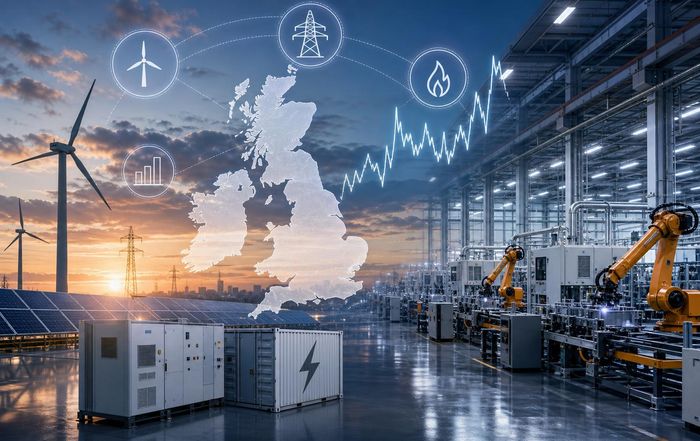
How UK Manufacturers Are Managing Their Energy Price Exposure
Energy has shifted from a background cost to a board-level risk for UK manufacturers. Since the start of Europe's gas crisis in 2021, wholesale prices have been volatile, government support schemes have come and gone, and decarbonisation pressures have intensified. For many energy-intensive businesses, power and gas are now among the largest and least predictable line items on the P&L, directly affecting margins, competitiveness, and investment decisions.
This page explores how UK manufacturers are managing that exposure in practice: how they buy energy, hedge risk, invest in efficiency and on-site generation, use data, and navigate policy and market reforms. It draws on guidance from regulators, industry bodies and real-world practices across sectors such as metals, chemicals, food and drink, and automotive.
Why energy price risk became a strategic issue
For decades, UK industrial energy prices moved within relatively predictable bands. That changed sharply when gas markets tightened in 2021, exacerbated by reduced Russian pipeline flows into Europe, low storage levels, and global LNG competition. Wholesale prices on the UK NBP gas and UK power markets spiked repeatedly, at points trading several times long-run averages. According to data collated by Ofgem and the Department for Energy Security and Net Zero (DESNZ), industrial energy prices in the UK surged through 2022 before easing, but volatility remains structurally higher than in the 2010s.
Manufacturers have been hit unevenly. Energy-intensive industries such as steel, glass, paper, fertilisers and ceramics typically consume large volumes of gas and power in continuous processes, so even modest price swings can materially change unit costs. Sectors like food and drink, plastics, and engineering are less intensive but still exposed, particularly where margins are thin and energy costs cannot be easily passed through to customers. Internationally traded manufacturers also face a competitiveness gap where rivals in the US, Middle East or parts of Asia enjoy cheaper and more stable energy.
Regulators and policymakers acknowledge this risk. Ofgem has reformed aspects of the non-domestic retail market and published guidance on business energy contracts, while DESNZ has introduced targeted support for energy-intensive industries and set out long-term plans for power market reform. Industry groups such as Make UK, the Confederation of British Industry (CBI) and the Energy Intensive Users Group (EIUG) have lobbied for more predictable policy and support frameworks. Against this backdrop, manufacturers have had to develop more sophisticated approaches to energy procurement, risk management and decarbonisation.
For readers interested in the broader macroeconomic backdrop and its effect on corporate costs, our economy coverage and global business section track how energy markets are influencing growth and inflation worldwide.
Procurement strategies: from fixed deals to active hedging
One of the most visible changes in the UK manufacturing sector has been the professionalisation of energy procurement. Many mid-sized businesses that once renewed a fixed-price contract every few years now treat energy like a raw material traded in financial markets.
In broad terms, manufacturers have several main options:
Fixed-price contracts remain attractive for smaller firms or those with limited risk appetite. A supplier offers a set unit price for power or gas over a period, often 12-36 months. This gives budget certainty but can lock a buyer into elevated prices if markets fall. During the 2022 spike, some firms that fixed at the peak found themselves uncompetitive versus peers that waited or used flexible contracts. Ofgem and the Competition and Markets Authority (CMA) have scrutinised some non-domestic contracts and broker practices, prompting calls for clearer information and fairer terms.
Flexible or "flex" purchasing has grown among larger manufacturers. Instead of buying all their volume at once, companies spread purchasing decisions over time, sometimes up to three years ahead, using wholesale market price triggers, volume caps and risk limits. This approach, often supported by energy consultants or suppliers' trading desks, aims to smooth price volatility and avoid buying at market extremes. It requires governance, trading mandates and close collaboration between finance, operations and procurement teams.
Pass-through contracts, where certain non-energy costs (network charges, environmental levies, balancing costs) are passed at cost, have become more common. These can be cheaper and more transparent but expose buyers to regulatory and system changes. The UK's ongoing review of network charges and the evolution of schemes such as the UK Emissions Trading Scheme (UK ETS) mean these elements can move significantly year to year.
Some very large energy users also hedge directly in wholesale markets or through financial instruments such as forwards and options, often via banks or commodity trading houses. This can allow more bespoke risk management but demands sophisticated risk controls and credit arrangements. Guidance from the Financial Conduct Authority (FCA) on derivatives and market conduct is relevant here, even if many industrial hedges are relatively straightforward.
A growing number of manufacturers are exploring long-term power purchase agreements (PPAs) with renewable generators. Under a corporate PPA, a business agrees to buy a share of output from a wind farm or solar project at an agreed price formula, typically over 10-15 years. This can provide long-term price visibility, support decarbonisation claims, and in some cases underwrite new generation capacity. Specialist PPA providers, utilities and advisory firms have developed standard structures to make these deals more accessible to mid-market companies.
Readers following the broader evolution of energy markets and corporate hedging will find additional context in our markets section and business coverage, where we track how commodity volatility feeds into corporate strategy.
Reducing demand: efficiency as the first line of defence
While procurement strategies can shape price exposure, the most durable way to manage energy risk is to use less energy per unit of output. The International Energy Agency (IEA) has repeatedly described energy efficiency as the "first fuel" for both competitiveness and climate goals, and UK manufacturers have increasingly embraced this view.
Many firms start with systematic energy audits, often guided by ISO 50001 energy management standards or support from organisations such as the Carbon Trust. These audits typically identify a hierarchy of measures, from low-cost behavioural and control changes to capital-intensive equipment upgrades. Common interventions include optimising compressed air systems, improving process insulation, recovering waste heat, upgrading motors and drives, and tightening control of start-up and shutdown procedures.
Lighting and building fabric upgrades (LEDs, smart controls, improved insulation) are now widespread, but the larger gains for manufacturers often come from process optimisation. For example, food and drink producers may fine-tune refrigeration and steam systems; chemical plants may improve reaction control and heat integration; metals firms may invest in more efficient furnaces and ladles. In many cases, payback periods of two to five years are achievable, particularly when energy prices are high.
Policy frameworks have nudged this along. The UK government's Industrial Energy Transformation Fund (IETF) has co-funded efficiency and fuel-switching projects, while climate-related reporting requirements under schemes such as Streamlined Energy and Carbon Reporting (SECR) have forced larger companies to quantify and disclose consumption and emissions. Banks and investors, including signatories to initiatives like the Glasgow Financial Alliance for Net Zero (GFANZ), increasingly scrutinise industrial energy and carbon performance when making lending and investment decisions.
For businesses seeking to align efficiency projects with broader sustainability goals, our sustainable business coverage and technology section regularly examine industrial decarbonisation technologies and financing models.
On-site generation and fuel switching: creating a partial hedge
Many UK manufacturers are no longer just energy consumers; they are becoming producers. On-site generation and fuel switching can create a natural hedge against volatile grid prices, though they introduce their own risks and capital requirements.
Solar photovoltaics (PV) have become particularly common on factory roofs and adjacent land, supported by falling equipment costs and corporate net-zero strategies. While UK solar output is variable, the generation profile often aligns reasonably with daytime manufacturing loads, reducing exposure to peak power prices. For some sites, behind-the-meter solar can supply 10-30% of annual consumption, with long-term levelised costs that look attractive against historic wholesale prices.
Combined heat and power (CHP) plants, typically gas-fired, have historically offered manufacturers an efficient way to produce both electricity and process heat on site. However, the economics of gas-fired CHP have been challenged by high gas prices, evolving carbon costs under the UK ETS, and changes to support schemes. Some manufacturers are now re-evaluating CHP investments, considering whether to retrofit for hydrogen-ready operation or to shift towards electric heat technologies as the power system decarbonises.
Biomass and biogas offer alternatives for certain sectors, particularly food and drink, paper, and waste processing, where residues can be used as fuel. These options can cut both energy costs and emissions, but they raise questions about feedstock availability, sustainability criteria, and air quality regulations. Guidance from the Environment Agency and schemes such as the Renewable Energy Guarantees of Origin (REGO) framework influence how these projects are structured and how their outputs are valued.
Battery storage is emerging as a complementary technology, allowing manufacturers to store cheap off-peak or on-site renewable power and use it at times of high grid prices. Some sites also participate in grid flexibility services, being paid by National Grid ESO to reduce demand or provide fast-response capacity when the system is stressed. This creates a new revenue stream and a more dynamic way to manage exposure to peak prices.
Fuel switching strategies increasingly consider the long-term trajectory of UK energy policy. DESNZ's Powering Up Britain and related strategies signal a direction of travel towards a cleaner, more electrified energy system. Manufacturers planning major investments in boilers, furnaces or process heat must weigh the risk of locking into high-carbon fuels against the potential volatility of electricity prices and the availability of low-carbon alternatives such as hydrogen, biomethane or advanced electrification technologies.
Data, digitalisation and demand flexibility
As energy has become more material, manufacturers have invested heavily in metering, data and digital tools to understand and influence their consumption in near real time. This is a natural extension of broader Industry 4.0 and industrial IoT trends, where production lines are increasingly instrumented and connected.
Smart meters and sub-metering allow companies to break down consumption by line, process or even product. Advanced analytics platforms, often cloud-based and supplied by energy management specialists or major IT vendors, can detect anomalies, benchmark performance, and identify optimisation opportunities. By integrating energy data with production planning and maintenance systems, manufacturers can schedule the most energy-intensive tasks for times of lower prices or higher on-site generation.
Demand-side response (DSR) has become a practical tool rather than a theoretical concept. Programmes run by National Grid ESO and aggregators pay businesses to reduce or shift load during periods of system stress or high wholesale prices. Manufacturers with flexible processes-such as cold storage, batch processing, or certain finishing operations-can participate without compromising product quality, effectively monetising flexibility that previously had no explicit value.
Digital twins and simulation tools are also gaining ground in energy-intensive sectors. By modelling a plant's processes and energy flows, engineers can test scenarios-such as different operating schedules, equipment configurations, or fuel mixes-before committing to physical changes. This can de-risk capital projects and help build investment cases for efficiency and decarbonisation measures.
For readers tracking the intersection of industrial operations, AI and energy management, our AI coverage explores how machine learning and optimisation algorithms are being applied to complex systems, including manufacturing plants and energy grids.
Navigating policy, regulation and support schemes
Managing energy price exposure in the UK is not just about markets and technology; it is also about understanding a shifting policy landscape. Support schemes, levies and regulatory changes can materially alter both costs and opportunities for manufacturers.
During the acute phase of the energy crisis, the UK government introduced temporary relief measures for non-domestic customers, later replaced by more targeted schemes. Energy-intensive industries in sectors such as steel, chemicals and paper have long had access to certain exemptions or compensations for policy costs, subject to eligibility criteria and state aid rules. Keeping track of which schemes apply, how they interact, and when they expire has become an important task for finance and energy managers.
Longer-term, reforms to the electricity market-such as proposals to decouple power prices from marginal gas costs, expand Contracts for Difference (CfDs), and develop new capacity and flexibility mechanisms-could change how manufacturers experience price risk. Ofgem, DESNZ and National Grid ESO regularly consult on changes to network charges, balancing costs and code governance, all of which can feed through to industrial bills. Trade associations and specialist energy advisors often play a key role in interpreting these developments for manufacturers.
Environmental regulation also matters. The UK ETS imposes a carbon price on emissions from certain industrial sites and power generation, influencing the relative costs of fuels and abatement options. Air quality regulations affect the feasibility of certain on-site generation and biomass projects. Product standards and extended producer responsibility rules can indirectly encourage more efficient manufacturing and lower-carbon inputs.
Internationally, policies such as the EU's Carbon Border Adjustment Mechanism (CBAM) and the US Inflation Reduction Act (IRA) are reshaping the competitive landscape. UK manufacturers exporting to the EU, for example, will need to account for embedded carbon in certain products, which is closely linked to energy sources and efficiency. Global policy shifts are therefore becoming part of the energy risk calculus, not just domestic rules.
Readers interested in how these policy changes intersect with trade, investment and corporate strategy can find broader analysis in our news and funding and investment coverage.
Financial planning, contracts and customer relationships
Energy price exposure is no longer solely an operational issue; it is deeply embedded in financial planning, contracting and customer relationships. Manufacturers are increasingly explicit about how they manage and share energy cost risk across the value chain.
On the financial side, treasury and finance teams model different price scenarios and stress-test margins, covenants and cash flows. Some businesses adopt formal risk appetites for energy-defining the maximum acceptable variance in energy costs relative to budget-and align procurement and hedging strategies accordingly. Lenders and credit insurers often ask for evidence of energy risk management as part of their due diligence, particularly for energy-intensive borrowers.
Commercially, many manufacturers now include energy cost adjustment clauses in contracts with customers, particularly for long-term supply agreements. These clauses may index part of the price to published energy or commodity benchmarks, or allow periodic renegotiation when costs move beyond predefined bands. While such mechanisms can protect margins, they must be carefully structured to remain acceptable to customers and compliant with competition and contract law.
Some companies use energy and carbon performance as a differentiator, especially where customers have their own net-zero commitments. Being able to demonstrate lower and more stable energy-related costs and emissions can support premium positioning, preferred supplier status, or long-term partnerships. Transparent reporting aligned with frameworks such as the Task Force on Climate-related Financial Disclosures (TCFD) helps build trust and can reduce perceived risk for investors and clients.
Labour and skills considerations also play a role. Energy management increasingly requires cross-functional capabilities: engineers who understand markets, finance professionals who grasp process constraints, and procurement teams who can engage with technical and policy issues. This intersects with the broader industrial skills agenda and the evolving jobs landscape covered in our jobs and labour market section.
Looking onwards, from crisis response to structural resilience
The initial shock of the energy crisis forced many UK manufacturers into rapid damage control: emergency contract renegotiations, temporary shutdowns, and urgent cash-saving measures. As markets have stabilised from their extremes, the emphasis has shifted towards building structural resilience.
In practice, that means combining several layers of defence: more sophisticated procurement and hedging; systematic efficiency improvements; strategic investments in on-site generation and flexibility; better data and digital tools; and active engagement with policy and regulation. No single measure eliminates energy price risk, but together they can turn a volatile, external shock into a more manageable, partly controllable variable.
The direction of travel in UK and global energy systems suggests that volatility will not disappear, even as more renewables come online and gas dependence gradually falls. Weather-driven output, evolving network constraints, and shifting policy frameworks will continue to shape price dynamics. Manufacturers that treat energy as a strategic resource-integrated into investment decisions, product design, supply chain strategy and financial risk management-are likely to be better positioned than those that view it purely as a utility bill.
For businesses and investors tracking these shifts, the intersection of energy, industry and policy will remain a defining theme of the coming decade. How UK manufacturers manage their energy exposure will not only determine their immediate cost base, but also their competitiveness and relevance in a decarbonising global economy.