

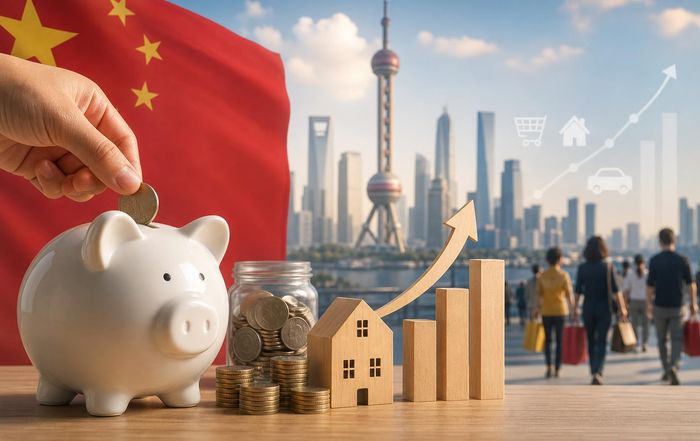
China's Household Savings: The Quiet Force Behind Its Consumer Recovery
China's consumer recovery is increasingly being shaped not by factories or property markets but by what households choose to do with an enormous pile of savings. After several years of pandemic disruption, property market stress, and policy uncertainty, Chinese households are sitting on trillions of renminbi in bank deposits and low-risk assets. Whether that money stays parked, trickles slowly into consumption, or is unleashed more decisively will go a long way toward determining China's growth trajectory, global demand, and even financial market sentiment over the next few years.
Take a look how China's household savings have changed, what is driving those shifts, and what they imply for the country's consumer recovery-and for businesses, investors, and policymakers watching from around the world.
How big is China's household savings cushion?
Chinese households have long been high savers by international standards, but the scale has grown dramatically. Data from the People's Bank of China (PBOC) show that household renminbi deposits surpassed 140 trillion yuan (roughly US$19 trillion) in 2024, almost double the level a decade earlier. During the pandemic years of 2020-2022, households added an unusually large amount to bank deposits as mobility restrictions curbed spending and uncertainty rose. By some estimates from institutions such as the International Monetary Fund (IMF) and OECD, "excess savings" accumulated during the pandemic reached the equivalent of several percentage points of GDP.
Unlike in the United States or parts of Europe, where excess savings were later run down as economies reopened, Chinese households have been reluctant to draw heavily on these buffers. PBOC data show that the growth of household deposits slowed but did not reverse after most COVID-related restrictions ended in late 2022. At the same time, consumer spending has recovered only gradually, with real retail sales growth lagging pre-pandemic trends and services spending rebounding unevenly across regions and income groups.
This divergence-large savings alongside a cautious consumption rebound-is central to understanding China's recovery prospects. It suggests that the constraint on consumption is less about capacity to spend and more about willingness to spend, shaped by deeper structural and psychological factors.
For readers following broader macro trends, this savings dynamic connects directly to China's economy and its evolving role in global demand, as well as implications for markets and corporate earnings worldwide.
Why do Chinese households save so much?
China's high household savings rate predates the pandemic. Several structural drivers have been well documented by organizations such as the World Bank, Asian Development Bank, and academic researchers at institutions like Peking University and Tsinghua University.
One major factor is demographics. China's rapid aging, combined with still-developing pension and healthcare systems, encourages precautionary saving. Although formal pension coverage has expanded, replacement rates and portability remain concerns, particularly for migrant workers and those in the private sector. Studies from the OECD and IMF have found that households with elderly members or expectations of higher future medical costs tend to hold significantly higher savings, and this relationship is particularly strong in China.
Another driver is the limited social safety net in areas such as unemployment insurance and education. Despite progress in expanding basic coverage, out-of-pocket spending on healthcare and education remains high relative to income for many families. This encourages parents to save aggressively for children's schooling and potential medical emergencies. In addition, the hukou (household registration) system still limits access to public services for some migrant workers in large cities, reinforcing the need for self-insurance.
Housing and property markets have also historically played a role. For two decades, home purchases were both a consumption goal and a primary investment vehicle. High down-payment requirements and rising prices pushed households to save large sums. Property ownership became a de facto retirement strategy for many, further boosting saving during working years. Although the ongoing property downturn has changed the calculus-reducing the perceived wealth effect and undermining confidence-it has not yet translated into a decisive shift away from high savings.
Finally, cultural and behavioral factors matter. Surveys by institutions such as the China Household Finance Survey (run by Southwestern University of Finance and Economics) show that Chinese households consistently report strong preferences for financial security over current consumption. This is reinforced by memories of economic volatility in earlier decades and by the significant income uncertainty perceived in private-sector employment.
Post-COVID: From forced saving to precautionary saving
The pandemic years introduced an additional layer of complexity. During 2020-2022, China's strict mobility controls and intermittent lockdowns meant that a portion of the increase in deposits was clearly "forced savings": households simply had fewer opportunities to spend on travel, dining, entertainment, and services. In theory, such savings could have been quickly deployed once restrictions were lifted, as occurred in the US and parts of Europe.
However, the reopening in late 2022 and 2023 coincided with mounting concerns about the property sector, labor market softness, and policy uncertainty. Major developers such as Evergrande and Country Garden faced financial distress, dragging down housing sales and prices in many cities. Meanwhile, youth unemployment rose sharply-so much so that the National Bureau of Statistics temporarily suspended publication of the youth jobless rate in 2023 before resuming with a revised methodology. For households, these developments signaled that income and asset values were less secure than previously believed.
As a result, much of the accumulated "forced savings" appears to have morphed into precautionary savings. Households that might have splurged on discretionary consumption instead kept money in bank accounts or shifted into relatively safe wealth-management products. The PBOC's quarterly surveys of urban depositors show a rising share of respondents reporting a preference for "more saving" rather than "more consumption" or "more investment," a trend that remained elevated even as COVID-related health risks diminished.
The shift from forced to precautionary saving is crucial for understanding why consumption has underwhelmed relative to the apparent financial capacity of households. It also explains why traditional stimulus tools, such as interest-rate cuts or liquidity injections, have had a limited impact on consumer behavior so far.
What are households doing with their money now?
The composition of household assets is changing alongside the overall level of savings. Historically, Chinese households were heavily concentrated in property and bank deposits, with relatively small allocations to equities and mutual funds. Over the past decade, financial liberalization and capital-market development have modestly diversified portfolios, but the shift has been cautious and uneven.
PBOC and China Securities Regulatory Commission data indicate that after a wave of enthusiasm for wealth-management products and equity funds in the late 2010s, households became more risk-averse again during the pandemic and amid stock-market volatility. Many wealth-management products have been restructured under new regulations, reducing implicit guarantees and exposing investors to more visible market risk. This has pushed some households back toward plain deposits, even as real returns on those deposits have been eroded by lower interest rates and moderate inflation.
At the same time, the property downturn has weakened the appeal of real estate as an investment. While some bargain-hunting has occurred in certain Tier-2 and Tier-3 cities, the national narrative has shifted from "housing as a one-way bet" to "housing as a risk." This reduces the perceived wealth of existing homeowners and makes prospective buyers more cautious about committing large amounts of savings to illiquid assets.
In this environment, households are effectively parking funds in low-risk, low-return instruments while they wait for clearer signals about the economy, job market, and policy direction. For the banking system, this deposit stability is helpful, but for consumption growth it represents untapped potential. It also shapes how domestic banking and markets evolve, as financial institutions adjust product offerings to a more risk-averse client base.
Can policy unlock household savings to boost consumption?
Policymakers in Beijing are well aware that household behavior is central to the next phase of growth. Official documents from the State Council, National Development and Reform Commission (NDRC), and PBOC have increasingly emphasized "expanding domestic demand," "promoting consumption," and "improving people's livelihood" as strategic priorities. The question is what mix of policies can convert precautionary savings into sustainable consumption without creating new financial imbalances.
One approach has been targeted support for big-ticket consumption items, such as autos and home appliances, often through time-limited subsidies or trade-in programs. Local governments have experimented with consumption vouchers and discounts to stimulate spending in restaurants, tourism, and retail. These measures can produce short-term boosts, especially in services, but they do not necessarily change long-term saving behavior.
Another track involves stabilizing the property market. Authorities have rolled out policies to support "reasonable" housing demand, ease mortgage terms in some cities, and encourage local governments and state-owned enterprises to purchase unsold housing inventory for conversion into affordable housing. The aim is to prevent a disorderly correction that would further erode household wealth and confidence. However, officials have also reiterated the principle that "housing is for living in, not for speculation," signaling that property will not return to its previous role as the main growth engine.
More structurally, reforms to social security, healthcare, and education financing could reduce the need for precautionary savings over time. Expanding the coverage and generosity of basic pensions, improving portability for migrant workers, and reducing out-of-pocket medical costs would all, in theory, encourage households to consume more and save less. These reforms, however, are complex, fiscally demanding, and politically sensitive, meaning progress is likely to be gradual.
Monetary policy can help at the margin by lowering borrowing costs and supporting credit to households and small businesses. The PBOC has cut key policy rates multiple times since 2022 and encouraged banks to reduce mortgage rates. Yet lower interest rates also reduce returns on deposits, and in an environment of high uncertainty, this does not automatically translate into more consumption. Households may simply save more to reach their perceived safety targets.
How do household savings shape consumer recovery scenarios?
Given these dynamics, analysts at institutions like the IMF, World Bank, and major investment banks have outlined several plausible paths for China's consumer recovery, each heavily influenced by household saving behavior.
In a more optimistic scenario, gradual improvements in the labor market, clearer signaling around property-market stabilization, and incremental social-policy reforms slowly rebuild confidence. Households begin to feel that income prospects are more secure and that extreme precautionary saving is less necessary. This leads to a measured drawdown of excess savings, supporting steady growth in discretionary consumption-particularly in services such as travel, healthcare, education, and leisure. The overall savings rate remains high by global standards but edges down, allowing consumption's share of GDP to rise.
In a more cautious scenario, uncertainty remains elevated. Property prices stabilize only weakly, youth unemployment stays high, and policy announcements are seen as fragmented or insufficient. Households maintain or even increase their savings rates, focusing spending on essentials and modest upgrades rather than major lifestyle changes. Consumption grows, but at a pace that keeps China firmly in a "subdued recovery" pattern. In this world, the large stock of household savings acts more as a buffer against shocks than as a driver of growth.
A more adverse scenario would involve renewed property-market stress, a significant labor-market setback, or a major external shock-such as a sharp downturn in global trade or an escalation in geopolitical tensions affecting supply chains. In that case, households might respond by further tightening spending and shifting even more aggressively into safe assets, reinforcing deflationary pressures. The savings cushion would still exist, but it would be held even more tightly, and the prospect of a consumption-led recovery would recede.
From a business and investor perspective, these scenarios frame strategic decisions. Consumer-facing companies, both domestic and multinational, must plan for a market where aggregate purchasing power is large but selectively deployed. Investors in Chinese equities and credit instruments need to assess how much of the savings stock can realistically be mobilized into consumption or financial assets, and over what time horizon.
Sectoral winners and losers in a high-savings environment
Even if aggregate consumption growth remains moderate, shifts in household preferences can create clear sectoral winners and losers. Surveys and spending data suggest that Chinese households are prioritizing perceived "quality of life" and "security" categories over purely discretionary or status-driven purchases.
Healthcare, insurance, and education-related services are likely to benefit from this pattern. Increased awareness of health risks, an aging population, and intense competition in schooling and skills training all support demand, even when households are cautious overall. Financial products that combine modest returns with strong safety features-such as bank wealth-management products with transparent risk profiles or guaranteed insurance-linked savings-may also attract a portion of household deposits.
On the other hand, sectors heavily reliant on property-linked spending, such as home furnishings, luxury renovation, and some construction-related categories, may face a more challenging environment. Big-ticket discretionary items, including certain segments of luxury goods or high-end automobiles, could see more volatility as households oscillate between aspirational consumption and financial prudence.
Digital platforms and technology-enabled services occupy a middle ground. Online retail, food delivery, and entertainment have remained resilient, as they often offer value and convenience. Yet tighter regulation of large internet platforms and concerns about job security in the tech and gig-economy sectors can also affect both supply and demand. For readers tracking innovation and technology trends, this intersection between household behavior and platform economics is increasingly important.
Internationally exposed sectors-such as export-oriented manufacturing and tourism-are influenced indirectly. If domestic consumption remains subdued, policymakers may lean more heavily on external demand and industrial upgrading to sustain growth, with implications for trade partners in North America, Europe, and across Asia.
What this means for global businesses and investors
China's household savings and consumption patterns are not just a domestic story; they ripple through global supply chains, commodity markets, and corporate earnings. Multinational firms in consumer goods, luxury, autos, travel, and digital services have long counted on Chinese demand as a key growth engine. A slower or more selective consumer recovery means recalibrating expectations and business models.
For global consumer brands, the size of China's middle class and upper-middle-income households still represents a major opportunity. However, strategies that assume rapid, broad-based spending growth may need revision. Companies may find more success targeting specific segments-such as health-conscious consumers, value-seeking households, or premium niches where brand and quality justify higher prices-rather than relying on mass expansion. Partnerships with local platforms and an understanding of evolving regulatory frameworks will also remain critical.
Investors in global equities and fixed income need to consider how China's savings behavior affects capital flows and risk appetite. If households keep a large share of their wealth in domestic deposits and low-risk assets, this can support the stability of China's banking system but may limit direct participation in equity markets. At the same time, Chinese institutional investors, including large banks and insurers, may continue to seek diversification abroad, influencing international capital markets.
For policymakers in other countries, China's cautious consumers have implications for trade balances and growth strategies. Economies that previously benefited from strong Chinese import demand for consumer and luxury goods may see more modest growth, while those supplying intermediate goods for China's manufacturing exports could remain more resilient. Global institutions such as the IMF, World Bank, and Bank for International Settlements have increasingly highlighted the importance of China's domestic rebalancing toward consumption for global economic stability.
People tracking business, funding, and founders will also note that a more cautious consumer backdrop can influence startup ecosystems, valuations, and the types of business models that attract capital, from fintech and AI applications to new retail formats and travel experiences.
The long game: From saving to spending?
China's household savings are both a challenge and an asset. On one hand, high precautionary saving constrains near-term consumption and complicates efforts to engineer a strong, domestically driven recovery. On the other, the existence of a large, liquid savings pool means that, in principle, there is ample capacity for higher consumption if confidence improves and structural reforms advance.
The trajectory from here will hinge less on one-off stimulus measures and more on whether households feel that their future is secure enough to loosen their grip on savings. That, in turn, depends on progress in stabilizing the property market without reigniting speculative excess, improving job prospects-especially for younger workers-and gradually strengthening social protection systems. Clear communication and policy consistency will be as important as the specific tools deployed.
For businesses and investors, the key is to recognize that China's consumer story has entered a more nuanced phase. Aggregate numbers may no longer surge as they did in earlier decades, but beneath the surface, shifts in household priorities are creating new patterns of demand and risk. Understanding how and why Chinese households save-and what might persuade them to spend-will be essential for anyone looking to navigate China's evolving role in the global business and news landscape.
External stakeholders may not be able to dictate the pace of China's consumer recovery, but by paying close attention to household balance sheets and sentiment, they can better anticipate where opportunities and vulnerabilities are likely to emerge.