

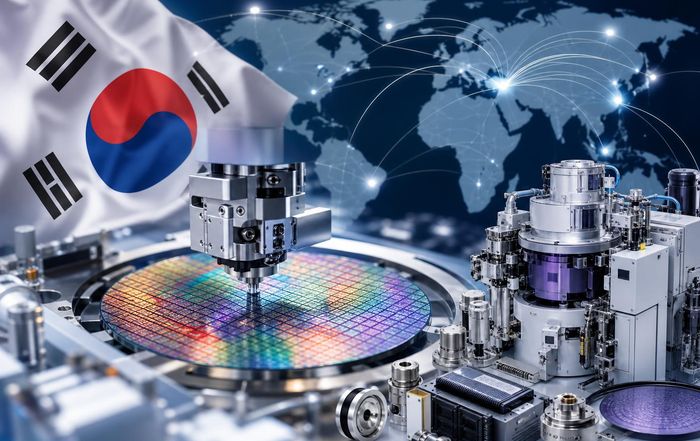
South Korea's Chip Equipment Supply Chain Finds New Niches
South Korea's semiconductor industry is usually discussed in terms of finished chips and memory giants like Samsung Electronics and SK hynix. Yet a quieter shift is underway further upstream. A dense ecosystem of tool makers, materials suppliers, and component specialists is carving out new niches in the global chip equipment supply chain, helped by geopolitical realignments, export controls on China, and the push into advanced nodes, AI chips, and next-generation memory. This evolution is reshaping how South Korea fits into the global technology economy and how resilient its semiconductor base may be in the next downturn.
From fast follower to indispensable partner
For much of the past two decades, South Korea's chip tool ecosystem was seen largely as a cost-competitive follower to entrenched US, European, and Japanese leaders. Companies like Applied Materials, Lam Research, KLA, ASML, Tokyo Electron, and Hitachi High-Tech dominated core process tools, while Korean firms focused on consumables, sub-systems, and mid-range equipment tailored to domestic fabs. According to data from bodies such as SEMI and IC Insights, South Korea's equipment vendors historically captured only a small share of global wafer fab equipment spending, even as the country accounted for a major portion of memory capacity.
That balance has started to change. As memory scaling has grown more complex, Samsung and SK hynix have needed closer, faster, and more customized support from their tool suppliers. Korean equipment firms, many of them smaller and more specialized, have taken advantage of this by co-developing process modules, inspection tools, and advanced cleaning or deposition systems directly with domestic fabs. This tight integration, often involving joint development agreements and early access to new process flows, has helped Korean tool makers embed themselves in high-value parts of the production stack rather than remaining generic commodity suppliers.
At the same time, global geopolitics has elevated the strategic importance of a diversified semiconductor supply chain. The US-China technology rivalry, export controls on advanced tools to China, and the rush by governments in the US, Europe, and Asia to onshore critical chip capacity have all increased demand for alternative equipment sources and localized ecosystems. This environment has created an opening for South Korean firms to step up as credible second-source or co-primary suppliers in areas once dominated by a handful of incumbents, especially for memory-centric processes where Korean fabs lead.
For readers tracking broader market implications, this shift intersects directly with themes we cover in technology, markets, and global industrial policy.
Geopolitics, export controls, and the "China factor"
No discussion of the new niches in South Korea's chip equipment supply chain is complete without the China dimension. Since 2019, and especially following the US October 2022 and 2023 export control updates on advanced semiconductor equipment, non-Chinese tool vendors have faced tight restrictions on selling leading-edge tools to Chinese fabs. The US Department of Commerce's Bureau of Industry and Security (BIS), working with allies like Japan and the Netherlands, has limited access to extreme ultraviolet (EUV) lithography, advanced logic tools, and certain memory equipment above defined performance thresholds.
For Korean equipment firms, this has had two opposing effects. On one hand, it closed off or complicated some potential sales to China, which remains the world's largest single semiconductor market by revenue. On the other, it created strong incentives for Chinese chipmakers to seek tools that are not explicitly covered by the harshest restrictions, as well as for non-Chinese fabs to diversify suppliers in case of future policy shocks. Korean vendors that specialize in mature-node tools, sub-critical process steps, or equipment categorized outside the strictest control lists have seen growing interest from Chinese and other Asian customers.
Meanwhile, South Korea itself has been balancing its security alliance with the United States and its deep trade ties with China. The government in Seoul has aligned with key US export control measures, while also working to protect domestic firms from sudden revenue shocks. Official trade data from bodies like Korea Customs Service and KOTRA show that semiconductor equipment exports to China have become more volatile, while shipments to other Asian countries, the US, and Europe have grown. This re-routing of demand has reinforced the need for Korean equipment makers to develop differentiated offerings rather than competing purely on volume sales to a single market.
At a strategic level, the geopolitically driven re-wiring of supply chains has also encouraged governments and industry groups such as SEMI and the World Semiconductor Council to stress supply chain resilience and multi-sourcing. Korean firms, already tightly integrated with Samsung and SK hynix, can leverage this environment to become indispensable partners for other memory and logic producers seeking alternatives to a small club of Western and Japanese equipment giants.
Readers interested in the policy and macro backdrop may find further context in our economy and news coverage.
AI, HBM, and the memory-centric advantage
The global boom in AI accelerators, driven by companies like NVIDIA, AMD, and Intel, has dramatically increased demand for high-bandwidth memory (HBM) and advanced DRAM. South Korea, home to the leading HBM suppliers, has a structural advantage here. The highly customized processes required for HBM stacking, through-silicon vias (TSVs), wafer thinning, and advanced packaging have opened up new niches for domestic equipment makers that can co-engineer tools with Samsung and SK hynix at the bleeding edge.
HBM production is particularly tool-intensive in areas such as wafer bonding, metrology and inspection, fine-pitch bumping, and cleaning between stacking steps. Korean firms that build bonding tools, laser equipment, advanced cleaners, or defect inspection systems optimized for memory structures can capture outsized value as HBM volumes scale. Because HBM is still a relatively young and fast-moving product category, incumbents do not always have off-the-shelf solutions, giving agile Korean companies an opportunity to define de facto standards in certain process steps.
The same is true for next-generation DRAM (such as DDR5 and beyond) and for emerging non-volatile memory technologies. As cell structures become more three-dimensional and as aspect ratios increase, new deposition, etch, and cleaning challenges arise. Korean tool makers, working closely with local fabs' R&D lines, can prototype and refine solutions in real production environments, then take those tools to international customers. This model mirrors how some Japanese and European firms historically grew by first serving "home" champions, then expanding globally once their tools were proven.
The AI wave also has implications for logic and advanced packaging, where Korean firms are seeking footholds in areas like panel-level packaging, fan-out wafer-level packaging, and 2.5D/3D integration. While Taiwan and the US remain central in advanced logic, the global demand for AI-ready packaging capacity is so large that it creates room for multiple regional ecosystems. Here, Korean equipment makers can partner with global OSATs (outsourced semiconductor assembly and test companies) and foundries to supply specific modules or subsystems even if they do not control the entire tool category.
This convergence of AI, memory, and packaging aligns with broader themes in AI and technology that we track across markets.
Domestic champions and the rise of specialized suppliers
At the heart of South Korea's equipment evolution is a set of domestic champions and a long tail of specialized small and medium-sized enterprises (SMEs). While individual company names and product lines vary, several common patterns are visible across the ecosystem.
First, many Korean equipment firms started as component or subsystem suppliers to global tool makers, providing vacuum chambers, gas delivery systems, RF power components, or advanced motion systems. Over time, some of these firms have climbed the value chain, developing complete tools that integrate their core strengths. This mirrors broader industrial trends in South Korea, where firms in automotive, display, and battery supply chains have also moved from supplying parts to building full systems.
Second, close geographic and cultural proximity to Samsung and SK hynix has enabled iterative co-development cycles that would be difficult for more distant suppliers. Engineers from Korean tool firms can be embedded in fabs, respond quickly to line issues, and adjust designs based on real-time feedback. This collaborative model is similar to what observers see in Taiwan's relationship between TSMC and its equipment ecosystem, but with a stronger memory focus.
Third, the Korean government and industry bodies such as Korea Semiconductor Industry Association (KSIA) have identified semiconductor equipment and materials as strategic sectors. Various policy measures, including R&D tax incentives, targeted funding, and support for export promotion, aim to reduce reliance on imported tools and to boost domestic capabilities. While South Korea is not alone in using industrial policy in this sector-the US CHIPS and Science Act, the EU Chips Act, and Japan's subsidies for domestic fabs all play similar roles-Korea's focus on equipment and materials complements its already strong position in manufacturing.
This web of relationships has spawned a deeper ecosystem of process-specific suppliers: firms that specialize in wet benches and cleaning, metrology systems tailored to 3D NAND, furnace and thermal processing tools, or niche packaging equipment. Rather than competing head-on with ASML in EUV or Applied Materials in broad deposition portfolios, these companies aim to dominate narrower slices of the process flow where they can differentiate on performance, cost of ownership, or service responsiveness.
Readers following corporate strategy and startup activity may find related insights in our founders and funding sections, where similar patterns of specialization are visible in other deep-tech domains.
Competing and collaborating with global incumbents
Despite their progress, South Korean equipment makers still operate in a landscape dominated by a few global incumbents. ASML effectively monopolizes EUV lithography. Applied Materials, Lam Research, Tokyo Electron, and KLA hold entrenched positions in deposition, etch, and inspection. Japanese firms retain strongholds in cleaning, resist, and certain metrology tools, while European and US companies lead in advanced process control and design-for-manufacturing software.
In this environment, Korean vendors often pursue a dual strategy of competition and collaboration. On the competitive side, they target segments where incumbents are less focused or where memory-specific requirements diverge from logic-centric tool roadmaps. For example, a tool optimized for high-aspect-ratio etching in 3D NAND or for particular DRAM capacitor structures may be less of a priority for a global vendor geared toward logic customers, creating a window for Korean specialists.
On the collaborative side, Korean firms may act as sub-suppliers or joint development partners to global tool makers. This can involve providing key modules, software components, or region-specific customization, even as the global brand retains control of the overall tool. Such arrangements can be mutually beneficial: incumbents gain local expertise and fast iteration, while Korean firms secure stable revenue and access to global customer bases. However, they also raise longer-term strategic questions about intellectual property, bargaining power, and the ability of Korean firms to build their own global brands.
Regulatory scrutiny is another factor. Competition authorities in major markets like the European Commission, the US Federal Trade Commission, and the Korea Fair Trade Commission pay close attention to consolidation and potential anti-competitive practices in critical technology supply chains. While there has not yet been a wave of large cross-border acquisitions in Korean equipment, any such moves would likely face detailed review given the strategic sensitivity of the sector.
For investors and analysts tracking these dynamics, broader coverage of banking and capital flows in banking and markets can help contextualize how equipment makers finance expansion and navigate regulatory oversight.
Materials, sustainability, and process innovation
Another emerging niche for South Korea lies at the intersection of equipment, materials, and sustainability. Advanced chip manufacturing is extraordinarily resource-intensive, consuming large volumes of ultrapure water, specialty gases, and electricity. Environmental regulations and corporate net-zero commitments are pushing fabs to reduce emissions, recycle more water and chemicals, and cut energy use per wafer.
Korean companies have longstanding strengths in chemicals, gases, and materials, including photoresists, slurry, and specialty films. As environmental pressures mount, equipment that can minimize chemical consumption, enable closed-loop recycling, or reduce the energy intensity of thermal processes gains competitive advantage. Korean vendors that integrate process and materials know-how into "eco-optimized" tools can differentiate themselves not just to domestic fabs but to global customers facing similar regulatory and investor scrutiny.
International organizations such as the International Energy Agency (IEA) and the World Economic Forum have highlighted the rising energy demands of data centers and AI workloads, indirectly increasing the focus on the upstream environmental footprint of chip production. In parallel, technology companies and institutional investors are paying closer attention to ESG metrics, including Scope 3 emissions that encompass supply chains. This creates a market pull for equipment that enables greener fabrication.
South Korea's own climate and industrial policies, aligned with its 2050 carbon-neutrality target and guided by ministries such as the Ministry of Trade, Industry and Energy (MOTIE), are likely to encourage R&D in low-carbon processes. For example, developing plasma processes that require less fluorinated gas, or tools that make it easier to switch to lower-impact chemistries, can open new niches for Korean firms that sit at the intersection of equipment and materials science.
Readers following the broader sustainability angle may find relevant context in our sustainable coverage, where similar pressures are reshaping batteries, automotive, and heavy industry.
Workforce, talent, and the risk of over-concentration
The expansion of South Korea's chip equipment ecosystem also depends on human capital. Advanced tool design requires a mix of mechanical, electrical, software, materials, and process engineering skills, along with deep familiarity with fab operations. Korean universities and research institutes such as KAIST, POSTECH, and Seoul National University have strong engineering programs, and government initiatives aim to channel more graduates into semiconductor-related fields.
Yet there are challenges. The global semiconductor industry faces a widely documented talent shortage, with organizations like McKinsey & Company and Deloitte projecting significant gaps in skilled engineers and technicians over the coming decade. South Korea competes with the US, Taiwan, Japan, and Europe for a limited pool of experienced chip professionals. Within Korea, large employers like Samsung and SK hynix attract much of the top talent, leaving smaller equipment firms struggling to hire and retain specialized engineers.
Over-concentration is another risk. While the tight coupling between Korean equipment makers and domestic memory giants is a strength, it can also be a vulnerability if demand in memory swings sharply or if a major customer shifts strategy. Diversifying the customer base to include global foundries, logic producers, and OSATs can mitigate this, but it requires sustained investment in global sales, service networks, and product adaptation.
Government programs and industry associations are responding with efforts to train more technicians, support mid-career re-skilling, and encourage collaboration between academia and industry. For readers interested in the labor-market side of this transition, our jobs coverage explores how high-skill manufacturing roles are evolving in advanced economies.
How far can South Korea climb in the equipment hierarchy?
Looking ahead, the central question is not whether South Korea's chip equipment supply chain will grow-it already is-but how far up the hierarchy it can climb. A few scenarios stand out.
One scenario sees Korean equipment firms solidify their roles as indispensable, highly specialized suppliers in memory and packaging, without displacing incumbents in the broadest tool categories. In this world, they capture attractive margins in niches like HBM process tools, memory-specific metrology, and eco-optimized cleaning systems, while global giants continue to dominate lithography, general-purpose deposition, and etch. South Korea's value proposition would be depth rather than breadth.
A more ambitious scenario would involve one or more Korean firms emerging as global leaders in at least one major equipment category beyond memory-specific niches-for example, advanced packaging platforms, certain types of deposition, or AI-optimized inspection and process control. Achieving this would likely require significant R&D investment, international M&A, and the ability to build strong global service organizations, as well as navigating complex export control and competition rules in markets like the US, EU, and China.
A more cautious scenario recognizes potential headwinds: prolonged downturns in memory pricing, geopolitical shocks that restrict market access, or aggressive competitive responses from incumbents that squeeze margins in targeted niches. In this case, the Korean ecosystem might still grow in absolute terms but remain constrained by the capital-intensive, cyclical nature of the industry and by its dependence on a few large domestic customers.
In practice, South Korea's trajectory may blend elements of all three. The country's chip equipment ecosystem is already more sophisticated and globally connected than it was a decade ago, and structural shifts-AI demand, supply chain diversification, sustainability pressures, and industrial policy-are likely to keep creating new niches. The challenge will be to convert today's tactical opportunities into durable strategic positions that can withstand both technological change and geopolitical uncertainty.
For business leaders, investors, and policymakers watching the semiconductor landscape, South Korea's evolving role in chip equipment is a critical signal. It shows how a country long known for manufacturing prowess is trying to move deeper into the upstream technologies that will define who captures the next wave of value in the global electronics economy.