

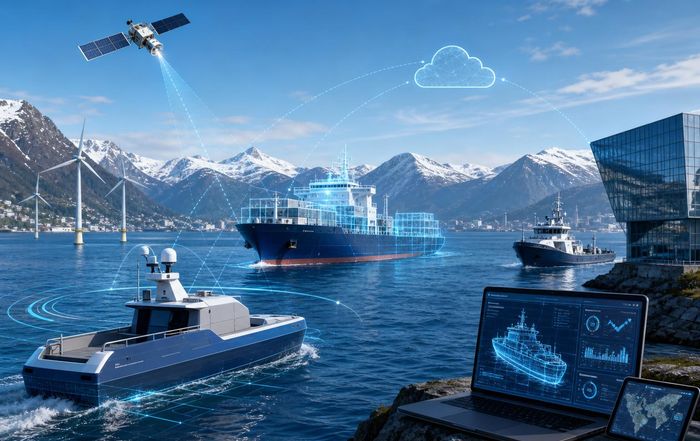
Norway's Maritime Technology Sector Bets on New Digital Tools
Norway's maritime technology ecosystem is in the midst of a significant digital upgrade. Shipowners, yards, equipment makers, and software firms are testing and deploying a new wave of tools built around AI, digital twins, advanced sensors, and high-bandwidth connectivity. The push is driven by three converging pressures: stricter climate regulation, volatile freight markets, and a shortage of skilled labor. Together they are forcing an industry known for steel and diesel to think more like a software business.
For our visitors watching the future of shipping, offshore energy, and ocean industries, Norway offers a revealing testbed. The country combines a large merchant and offshore fleet, strong public funding for research, and a dense cluster of maritime suppliers. What is being piloted in Norwegian fjords today is likely to influence how vessels are designed, built, operated, and financed across major shipping hubs from Singapore to Rotterdam in the coming decade.
Why Norway Is Becoming a Digital Testbed at Sea
Norway's maritime cluster is unusually integrated. Major shipowners, such as Wilhelmsen and Odfjell, operate side by side with offshore players, shipyards, class societies, and a long tail of specialized technology suppliers. According to Maritime Bergen and Norwegian Maritime Exporters, the broader ocean industries account for a substantial share of Norwegian exports and high-skilled jobs, giving policymakers a strong incentive to support modernization.
The Norwegian government has explicitly targeted the "green and digital transition" of maritime industries through funding schemes under Innovation Norway, the Research Council of Norway, and state-backed investment vehicles like Enova. These institutions co-finance demonstration projects ranging from hybrid ferries to autonomous coastal vessels and AI-driven route optimization. That public backing, combined with a relatively small and collaborative industry, lowers the risk of experimenting with unproven tools that might take much longer to gain traction in more fragmented markets.
Regulation also plays a role. The International Maritime Organization (IMO) has tightened efficiency and carbon-intensity rules, and the European Union has brought international shipping into its EU Emissions Trading System (EU ETS). Norwegian shipowners active on European routes now face a real cost for every tonne of CO₂, which makes investments in digital efficiency tools easier to justify. At the same time, Norway's own Norwegian Maritime Authority and classification societies such as DNV and Lloyd's Register are developing frameworks for remote surveys, digital documentation, and autonomous operations, creating a legal environment in which novel digital solutions can actually be used rather than remaining lab prototypes.
For investors, founders, and established maritime suppliers following developments via global business, economy, and technology coverage, Norway's cluster offers early signals of which digital tools may scale internationally and which may stall.
Digital Twins Move From Buzzword to Working Tool
Among the most visible changes is the spread of digital twins-virtual replicas of vessels, engines, or whole systems that are continuously updated with real-world data. Norwegian companies were early adopters, but until recently many projects remained confined to R&D. That is starting to change as shipowners look for concrete savings and regulators accept more digital evidence in areas like stability calculations and machinery condition.
Kongsberg Maritime, a major Norwegian supplier, has developed digital twins for propulsion systems, dynamic positioning, and entire vessels, using onboard sensor data to simulate performance and predict failures. DNV, one of the world's largest classification societies, has invested heavily in digital twin methodologies for structural integrity and machinery health, positioning them as tools to reduce dry-dock time and extend the life of critical components. These efforts are complemented by research at institutions such as the Norwegian University of Science and Technology (NTNU) and SINTEF, which test how twins can support autonomous operations and complex offshore installations.
On the operational side, several Norwegian ferry and offshore support operators are experimenting with twins that combine weather data, cargo information, and engine telemetry to test alternative operating profiles before implementing them on the actual vessel. Instead of relying solely on experience or static manuals, crews and shore-based teams can run "what-if" scenarios in software, then adjust speed, route, or power management accordingly. This is particularly relevant for companies trying to cut fuel use and emissions to remain competitive as carbon pricing expands and sustainability expectations rise-topics that are increasingly central in global markets and sustainable business discussions.
However, digital twins bring challenges. Building and maintaining accurate models requires high-quality data and domain expertise, and many older vessels lack the necessary instrumentation. Cybersecurity also becomes more critical as operational technology is tied more tightly to cloud platforms run by vendors like Microsoft, Amazon Web Services, and Google. Norwegian projects have therefore focused not just on impressive simulations but on governance: who owns the data, who is liable if a twin-based recommendation proves wrong, and how to standardize interfaces so that a twin built for one shipyard or owner can be reused elsewhere.
AI on the Bridge and in the Engine Room
Artificial intelligence is another area where Norway's maritime sector is testing practical applications rather than abstract concepts. While fully autonomous ocean-going ships remain rare, AI-assisted decision-making is already making its way onto bridges, into engine rooms, and across shore-based operations centers.
Route optimization is one of the most mature use cases. Several Norwegian and Nordic startups and established firms offer AI-driven voyage planning tools that combine weather forecasts, ocean currents, port congestion data, and vessel-specific performance curves. These platforms aim to minimize fuel use and emissions while maintaining schedules, a priority as cargo owners and charterers face more scrutiny over their supply-chain emissions from initiatives such as the Sea Cargo Charter and regulatory moves by the European Commission. For shipowners operating under tight margins, even a few percentage points of fuel savings can materially affect earnings, making AI-based routing a relatively low-risk starting point for digitalization.
Predictive maintenance is another focus. Norwegian offshore support and aquaculture fleets operate in harsh conditions where unplanned downtime is costly. By applying machine-learning models to vibration, temperature, and pressure data from critical components, operators can identify patterns that precede failures and schedule interventions more efficiently. Classification societies like Bureau Veritas and DNV are working with owners to ensure that such condition-based maintenance approaches are recognized within formal survey regimes, helping convert AI insights into regulatory compliance and cost savings.
On the bridge, several Norwegian trials involve computer-vision systems that assist with collision avoidance, particularly in congested fjords or during poor visibility. These systems combine camera feeds with radar and AIS data, then highlight potential risks or suggest course adjustments. While human officers remain in charge, the tools aim to reduce cognitive load and improve situational awareness, a growing concern as crews become smaller and voyages more complex. Research projects under the Norwegian Coastal Administration and universities are also exploring how AI can support autonomous navigation for short-sea routes, including urban waterborne transport.
These developments intersect with broader AI debates. Norway's maritime sector must navigate emerging rules from bodies like the European Union on trustworthy AI, as well as cybersecurity guidance from agencies such as the European Union Agency for Cybersecurity (ENISA). For global stakeholders, Norway's experiments may provide early evidence of how to balance efficiency gains with safety, accountability, and crew acceptance.
From Paper Charts to Cloud Platforms: Data Infrastructure at Sea
Digital tools depend on robust data infrastructure, and here too Norway is moving quickly. Historically, maritime operations relied on paper documentation, local spreadsheets, and siloed shipboard systems. That is changing as owners adopt cloud-based fleet management platforms, electronic logbooks, and integrated bridge and engine-room systems.
High-bandwidth satellite connectivity from providers like Starlink, Inmarsat, and Intelsat has been a turning point. Norwegian coastal and offshore vessels are among the early adopters of low-Earth orbit (LEO) connectivity, which offers higher speeds and lower latency than traditional geostationary satellites. This makes it feasible to stream sensor data continuously, conduct remote inspections via video, and even deploy software updates to vessels in near real time. It also supports crew welfare, as seafarers expect the same connectivity at sea that they have on shore, a factor increasingly important in global jobs and talent-retention discussions.
At the same time, the shift to cloud platforms raises concerns about vendor lock-in and data fragmentation. Norwegian shipowners often work with a mix of global software providers and local niche vendors, each with its own data model and interface. Industry bodies and research consortia are therefore pushing for open standards and interoperable APIs, so that data collected by one system-say, a fuel-monitoring tool-can be reused by another, such as a charter-party performance platform or an emissions-reporting module.
Regulators are also adapting. The Norwegian Maritime Authority and international bodies like the IMO are gradually recognizing electronic certificates, digital record books, and remote surveys, reducing the need for physical documents and on-site inspections. This is particularly relevant as environmental reporting requirements proliferate, including mandatory greenhouse-gas reporting under EU rules and voluntary disclosure frameworks promoted by organizations such as the Task Force on Climate-related Financial Disclosures (TCFD) and the Poseidon Principles for ship finance. Norwegian firms are testing integrated digital reporting pipelines that can feed data from onboard systems directly into compliance and financing workflows, an area closely watched by banks and investors across banking and finance and funding markets.
Autonomy, Remote Operations, and New Vessel Concepts
Perhaps the most visible symbol of Norway's maritime digital experimentation has been the development of autonomous and remotely operated vessels. Projects such as the fully electric, container-carrying Yara Birkeland, developed by fertilizer company Yara International with technology partners including Kongsberg, have been widely cited as proof-of-concept for low-carbon, automated short-sea shipping. While the vessel's journey from concept to regular operations has taken longer than early publicity suggested, it has helped clarify what is technically and legally feasible.
Norwegian research programs supported by the Norwegian Research Council and Innovation Norway are also exploring autonomous coastal ferries, urban water shuttles, and remotely operated offshore vessels. The goal is not to remove humans entirely but to shift more tasks to shore-based control centers, where fewer people can oversee more vessels with better tools. This could help address crew shortages, reduce costs, and enable new business models, such as on-demand waterborne transport in cities.
Class societies and regulators are building the rulebooks in parallel. DNV, Lloyd's Register, and the American Bureau of Shipping (ABS) have all published guidance on autonomy levels, remote control, and cyber-risk management. The IMO and national authorities like the Norwegian Maritime Authority are working on frameworks for Maritime Autonomous Surface Ships (MASS), including collision regulations, liability, and certification. Norway's early trials provide real-world data to inform these debates, influencing how other jurisdictions-from the United Kingdom Maritime and Coastguard Agency to Singapore's Maritime and Port Authority-shape their own approaches.
For ports and logistics providers, these developments connect directly to wider global and news trends around smart ports, just-in-time arrivals, and integrated supply-chain visibility. Autonomous or semi-autonomous vessels are easier to integrate into digitally orchestrated port calls, where berths, pilots, tugs, and hinterland transport are scheduled dynamically.
Sustainability and Regulation as Digital Catalysts
Norway's maritime digitalization cannot be separated from the sustainability agenda. International and regional rules now link emissions performance to commercial viability, making digital tools a necessity rather than a luxury.
The IMO's energy-efficiency regulations (EEXI and CII), alongside the EU ETS and upcoming fuel-intensity rules under the FuelEU Maritime initiative, require detailed measurement and reporting of fuel use, routes, and cargo. Shipowners that cannot demonstrate compliance or cost-effectively cut emissions may find their vessels less attractive to charterers and financiers. Digital monitoring and analytics platforms are therefore being tested across Norwegian fleets to track consumption in real time, simulate alternative fuels, and optimize voyages.
Sustainability-linked financing amplifies this effect. Banks adhering to the Poseidon Principles and cargo owners following the Sea Cargo Charter use emissions-intensity metrics in their decision-making. Norwegian owners seeking capital or long-term contracts increasingly need credible, data-rich decarbonization plans. This pushes them toward integrated digital solutions that can link onboard performance to corporate-level environmental, social, and governance (ESG) reporting-an area also shaped by guidelines from bodies such as the International Financial Reporting Standards (IFRS) Foundation and the Global Reporting Initiative (GRI).
Norway's strong position in offshore wind, subsea services, and aquaculture adds another dimension. Vessels serving these sectors must operate efficiently in dynamic environments, often under close environmental scrutiny. Digital tools that help plan routes around marine protected areas, minimize noise and emissions near sensitive ecosystems, or coordinate with offshore wind-farm control systems are increasingly part of project requirements. This creates additional demand for Norwegian maritime technology firms that can combine operational know-how with advanced software, data, and AI.
Barriers, Risks, and the Human Factor
Despite the momentum, digital transformation in Norway's maritime sector faces real obstacles. Many vessels have long lifecycles and were not designed with extensive digitalization in mind. Retrofitting sensors, upgrading networks, and integrating legacy systems can be costly and disruptive. Smaller shipowners, which make up a large part of the Norwegian and global fleets, often lack the capital and in-house expertise to manage complex digital projects, even when potential savings are significant.
Cybersecurity is a growing concern as operational technology becomes more connected. Attacks on port and shipping systems globally have highlighted the risk of operational disruption and data theft. Norwegian companies must align not only with IMO cyber-risk guidelines but also with broader frameworks like the EU's NIS2 Directive and standards promoted by organizations such as the International Organization for Standardization (ISO). This means investing in security-by-design, regular software updates, crew training, and incident-response capabilities-costs that may be hard to justify for operators focused on day-to-day survival in volatile freight markets.
The human factor is equally important. Many seafarers and shore-based staff are wary of tools that seem to second-guess their expertise or threaten jobs. Norwegian projects that have progressed fastest tend to involve crews early, use digital tools to support rather than replace human judgment, and provide clear training and feedback loops. Maritime academies and training centers in Norway are updating curricula to include data literacy, basic coding, and an understanding of AI and automation, but the skills gap remains a challenge-one mirrored in many other shipping nations.
Commercial fragmentation further complicates matters. Data ownership and sharing between shipowners, charterers, equipment suppliers, and software vendors can be contentious. Some Norwegian initiatives, often supported by public funding, explicitly aim to create shared data spaces and neutral platforms. Yet competitive and legal concerns mean that universal solutions remain elusive.
What Norway's Tests Mean for Global Maritime and Beyond
For international stakeholders in shipping, energy, finance, and technology, Norway's maritime digital experiments offer more than local interest. They provide early insight into how digital twins, AI, high-bandwidth connectivity, and autonomous systems might reshape cost structures, risk profiles, and competitive dynamics across global ocean industries.
Shipowners elsewhere can watch which Norwegian pilots move from prototype to fleet-wide deployment, and under what conditions. Technology firms can see where there is appetite for open, interoperable solutions versus proprietary ecosystems. Regulators and policymakers-from Brussels to Tokyo-can learn from Norway's attempts to align safety, environmental performance, and innovation, using that experience to refine their own frameworks.
For folks following shifts in business, technology, and global markets, Norway's maritime sector underscores a wider lesson: the energy transition and digital transition are increasingly inseparable. Cutting emissions, improving safety, and managing complex supply chains now depend as much on software, data, and connectivity as on new fuels or hull designs.
The coming years will show whether Norway can convert its head start into enduring advantages for its shipowners, yards, and technology firms-or whether the tools being tested in its fjords will be scaled and commercialized more aggressively elsewhere. Either way, the country's maritime digitalization journey has become a key reference point for anyone trying to understand how one of the world's oldest global industries is being rewired for a more connected, regulated, and carbon-constrained era.