

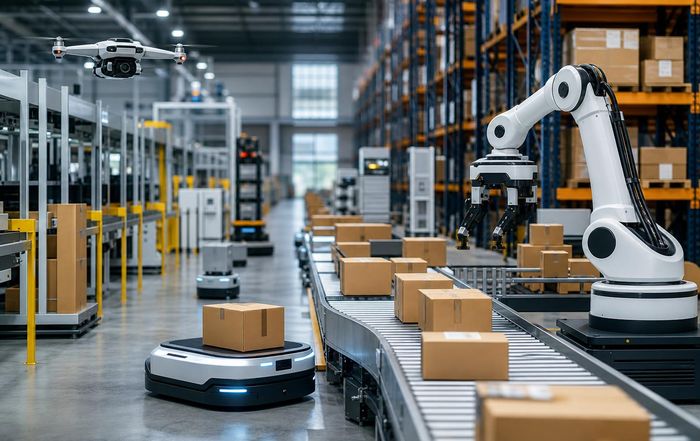
Why Dutch Logistics Firms Are Rethinking Warehouse Automation
Dutch logistics companies spent the past decade racing to automate. From the ports of Rotterdam to fulfillment hubs in Noord-Brabant, robots, automated storage and retrieval systems (AS/RS), and AI-driven software were marketed as the inevitable future of warehousing. In 2026, that narrative is being rewritten. Faced with higher-than-expected costs, integration headaches, shifting trade flows, and a cooler funding climate, logistics operators in the Netherlands are not abandoning automation-but they are becoming far more selective, pragmatic, and sometimes openly skeptical.
This reassessment matters well beyond Dutch borders. The Netherlands is a bellwether for global logistics: it combines one of the world's busiest ports, a dense consumer market, and a sophisticated network of third-party logistics (3PL) providers. How Dutch firms recalibrate their warehouse strategies offers an early signal of what may follow in other major logistics hubs.
From automation rush to reality check
The earlier wave of automation in the Netherlands was driven by three overlapping pressures. First, the country's role as a European gateway meant growing volumes through Port of Rotterdam and Amsterdam Schiphol Airport, especially in e-commerce and high-value goods. Second, chronic labor shortages-amplified by an ageing workforce and competition from other sectors-pushed warehouse operators to look for ways to do more with fewer people. Third, large shippers and retailers, including global e-commerce platforms, demanded ever shorter delivery times and higher order accuracy, putting stress on traditional manual operations.
Vendors of robotics and warehouse management systems promised a clear solution: automated guided vehicles (AGVs), robotic picking arms, shuttle systems, and AI-optimized routing. Consultancy reports and technology marketing often implied that failing to automate aggressively would leave logistics firms uncompetitive. Investment capital was readily available in a low-interest-rate environment, and Dutch logistics parks in regions such as Venlo and Tilburg became showcases for high-tech warehouses.
However, as interest rates rose and energy prices spiked following Russia's invasion of Ukraine, many assumptions underpinning the original business cases began to look optimistic. Operators discovered that the headline price of hardware was only part of the cost. Integration with legacy IT systems, building modifications, maintenance contracts, and the need for highly skilled technicians all added significant expense. For multi-client 3PL warehouses, where product mix and volumes change frequently, some highly specialized automation turned out to be less flexible than expected, forcing costly reconfiguration or underutilization of expensive equipment.
Regulatory and policy shifts also played a role. Dutch authorities tightened rules on nitrogen emissions and land use, limiting large-scale warehouse developments in some regions. That made it harder to justify long-payback investments in fixed infrastructure. At the same time, broader European discussions on AI and data governance, led by institutions such as the European Commission and the European Parliament, made some operators wary of locking themselves into opaque, vendor-controlled systems that might later face regulatory scrutiny.
Labor shortages, but not a robot-only answer
The Netherlands continues to face a tight labor market, with unemployment low and competition for workers intense across logistics, manufacturing, and services. Organizations such as Statistics Netherlands (CBS) and Eurostat have highlighted the structural nature of these shortages, driven by demographics and persistent demand. Yet the way Dutch logistics firms now talk about automation suggests they no longer see robots as a simple replacement for human labor.
Instead, many operators are repositioning automation as a tool to make warehouse jobs more attractive and sustainable rather than to eliminate them outright. Exoskeletons, collaborative robots (cobots), and pick-to-light systems are being deployed to reduce physical strain and improve safety. This is partly a response to stricter health and safety expectations, influenced by EU-level frameworks and national regulators, and partly a pragmatic recognition that logistics remains a people-centric business.
Unions and worker councils in the Netherlands, traditionally strong in sectors like transport and logistics, have also pushed for transparency about the impact of automation on jobs. Discussions often refer to research from bodies such as the International Labour Organization and the OECD, which emphasize that technology can both displace and create roles depending on how it is implemented. In practice, Dutch warehouse operators now commonly involve staff early in automation projects, focusing on retraining and upskilling rather than abrupt workforce cuts.
For firms that operate pan-European networks, this shift in mindset is also a brand and ESG issue. Investors and customers increasingly scrutinize social impacts alongside financial returns, a trend reinforced by initiatives from organizations like the World Economic Forum and reporting frameworks aligned with the Global Reporting Initiative. A warehouse full of robots but reliant on precarious temporary labor for the remaining tasks is no longer seen as future-proof.
The new economics of warehouse investment
Rethinking automation in Dutch logistics is as much about finance as about technology. Higher interest rates and more cautious lending standards have lengthened payback expectations. Banks and institutional investors scrutinize warehouse automation projects more critically, looking beyond simple labor-saving ratios to consider resilience, flexibility, and downside risk.
Whereas earlier projects often aimed at large, one-off transformations, current strategies favor modular, incremental deployments. Rather than committing to a fully automated facility designed around a single client or product category, many 3PLs now test smaller-scale solutions that can be scaled up or redeployed. Autonomous mobile robots (AMRs) that can operate in existing buildings without extensive fixed infrastructure have become particularly attractive, as they allow capacity to be added or removed in line with contract wins and seasonal peaks.
The economics are also shaped by changes in trade and supply chain design. Dutch logistics firms serve a wide range of markets, from domestic retail to pan-European e-commerce and global manufacturing. The pandemic, geopolitical tensions, and disruptions such as the Red Sea shipping crisis have encouraged many shippers to diversify routes and adjust inventory policies. This makes demand more volatile and less predictable at the warehouse level, undermining the assumptions behind high fixed-cost automation.
Industry groups such as Evofenedex and Transport en Logistiek Nederland (TLN) have noted that smaller and mid-sized logistics enterprises in particular are wary of investing in systems that require long, stable contracts to break even. Some are exploring shared automation models-where multiple 3PLs or shippers co-invest in robotics or high-density storage that can be moved between sites-but these arrangements are still experimental and raise complex questions about governance, liability, and data sharing.
For international readers tracking broader economic implications, these dynamics intersect with trends covered in areas such as business, economy, and markets, where capital allocation decisions in logistics increasingly influence trade flows and corporate earnings.
Technology choices: from "maximum automation" to "right automation"
Technologically, the Dutch logistics sector is shifting from a mindset of "maximum automation" to one of "right automation." Rather than assuming that more robotics and software always equate to higher performance, operators are segmenting their processes and choosing tools that match specific operational realities.
For fast-moving, high-volume e-commerce fulfillment centers serving large consumer markets in the Netherlands and neighboring countries, sophisticated shuttle systems and goods-to-person solutions still make sense. These sites can justify heavy investment because order profiles are relatively stable, throughput is high, and the cost of errors or delays is significant. Vendors of such systems, often based in Germany, Switzerland, and other European engineering hubs, continue to find receptive customers in Dutch logistics parks.
By contrast, warehouses handling heterogeneous cargo, project logistics, or multi-client B2B operations are more cautious. They favor flexible technologies such as AMRs, vision-assisted picking, and advanced warehouse management systems that can be adapted to new contracts without major rebuilds. Cloud-based platforms from firms like SAP, Oracle, and Microsoft are increasingly being integrated with transport management and yard management solutions, providing end-to-end visibility rather than just automating physical movements.
AI and data analytics are another area of selective adoption. Dutch operators are experimenting with predictive staffing, demand forecasting, and dynamic slotting algorithms, often in collaboration with universities such as TU Delft and Eindhoven University of Technology, which have strong reputations in logistics and robotics research. Yet many firms remain wary of "black box" systems, especially in light of forthcoming EU AI regulations. They prefer tools that can be explained to clients, auditors, and regulators, and that allow human override when conditions change unexpectedly.
Readers tracking broader technology and AI trends will recognize a familiar pattern: enthusiasm tempered by governance concerns, with a growing emphasis on explainability, interoperability, and vendor independence.
Sustainability, regulation, and the shape of Dutch warehouses
Sustainability is another powerful driver behind the reassessment of warehouse automation in the Netherlands. The country's dense population, limited land availability, and environmental pressures have sparked public debate about "dozen-dozen" (mega-warehouses) and their impact on landscapes, biodiversity, and nitrogen emissions. National and provincial governments have responded with tighter zoning rules and stricter environmental permitting, influencing how and where logistics facilities can expand.
Automation interacts with these constraints in complex ways. High-bay automated warehouses can, in theory, use land more efficiently by storing more goods vertically. They can also be designed to optimize energy use, for example by minimizing unnecessary movements and integrating with on-site solar or smart grid systems. Organizations such as the World Green Building Council and the Dutch Green Building Council promote standards and certification schemes that encourage energy-efficient, low-carbon logistics real estate.
However, highly automated facilities also require more specialized building designs and may be less adaptable if regulations or community expectations change. A warehouse optimized for one type of high-throughput e-commerce operation may not easily convert to other uses if a major client leaves or if zoning rules shift. This has led some Dutch logistics developers and investors to favor buildings that can support a range of automation scenarios without being locked into a single configuration.
The EU's broader Green Deal agenda and related initiatives shape these calculations. As reporting obligations expand and carbon pricing becomes more embedded in corporate decisions, shippers increasingly ask their logistics partners for granular data on emissions and resource use. Automation can help by generating detailed, real-time operational data, but only if systems are designed with measurement and reporting in mind. In this context, the distinction between "smart" and "automated" warehouses becomes important: intelligence and transparency may matter as much as physical robotics.
These issues intersect with coverage areas such as sustainable business and global trade, where environmental standards and logistics strategies are increasingly intertwined.
Startups, funding, and the changing innovation landscape
The Netherlands has been an active hub for logistics and robotics startups, often clustered around major ports and technical universities. In recent years, venture capital flowed into companies developing warehouse robots, computer vision systems, and optimization software, supported by European innovation programs and domestic accelerators. Platforms such as Techleap.nl and initiatives backed by the European Investment Bank helped connect founders with investors and corporate partners.
As global funding conditions tightened, however, the bar for logistics automation startups rose sharply. Dutch and international investors now look for clearer paths to profitability, stronger evidence of customer traction, and solutions that can be adopted without massive capital expenditure from end users. Startups that once aimed to replace entire warehouse systems now more often position themselves as modular add-ons that can integrate with existing infrastructure and software.
For logistics firms, this environment offers both opportunity and risk. On one hand, they have more leverage to negotiate pilot programs, revenue-sharing models, and performance-based contracts. On the other, they must be cautious about relying on early-stage vendors who may struggle to scale or survive market downturns. Corporate venture arms of large logistics and industrial companies, including those based in Germany, France, and the Nordic countries, play an increasingly prominent role in shaping which technologies gain traction.
This evolving innovation landscape is closely watched by readers interested in founders, funding, and the crossover between logistics tech and broader enterprise software. It also highlights a broader shift: experimentation continues, but the era of easy money for speculative warehouse automation concepts appears to be over.
Strategic implications for global supply chains
The way Dutch logistics firms are rethinking warehouse automation has implications for shippers and partners worldwide. Multinational manufacturers, retailers, and e-commerce platforms that rely on the Netherlands as a distribution hub will find a more cautious, but arguably more resilient, logistics sector.
One consequence is that service level agreements (SLAs) and contract structures are becoming more nuanced. Rather than promising blanket automation-driven efficiency gains, 3PLs are more likely to propose tiered service models, where highly automated solutions are reserved for stable, high-volume flows, while more flexible, semi-automated setups serve volatile or project-based business. This can change pricing structures and risk-sharing arrangements, with shippers sometimes asked to commit to longer-term volumes if they want access to the most advanced facilities.
Another impact is on network design. As automation becomes more modular and relocatable, the traditional distinction between "manual regional depot" and "fully automated mega-hub" blurs. Dutch operators may deploy mobile robotics and advanced software across multiple smaller sites, supporting nearshoring and multi-node distribution strategies. This aligns with broader trends toward resilience and redundancy in global supply chains, as highlighted by organizations such as the World Trade Organization and major consultancies.
For investors and policymakers, the Dutch experience underscores that warehouse automation is not a one-way street toward ever-higher capital intensity. Instead, it is a series of trade-offs between cost, flexibility, resilience, and social impact. As other logistics hubs-from Germany's Ruhr region to ports in Asia and North America-grapple with similar pressures, the Netherlands provides a case study in how a mature logistics ecosystem can adjust course without abandoning technological progress. Folks following events in banking and finance, jobs, and news will find that these strategic shifts ripple outward, influencing employment patterns, infrastructure investment, and even regional economic competitiveness.
Where the Dutch debate is heading
Looking ahead, the debate in the Netherlands is less about whether warehouses should be automated and more about how, where, and under what conditions. Key questions shaping boardroom and policy discussions include how to balance long-term capital commitments with uncertain trade flows, how to share the benefits and risks of automation between logistics providers and shippers, and how to ensure that technological progress aligns with social and environmental expectations.
Dutch logistics firms are unlikely to return to purely manual operations, but they are also stepping back from the idea that full automation is the inevitable end state. Instead, they are building hybrid models that combine human expertise, adaptable robotics, and increasingly sophisticated software. For global businesses watching from abroad, the message is clear: warehouse automation is entering a more mature, discriminating phase, and the Netherlands is one of the places where that transition is most visible. For those tracking these new shifts across sectors and geographies, related coverage in areas such as business, technology, economy, global trade, and AI will remain essential to understanding how logistics-and the broader world of commerce it underpins-continues to evolve.