

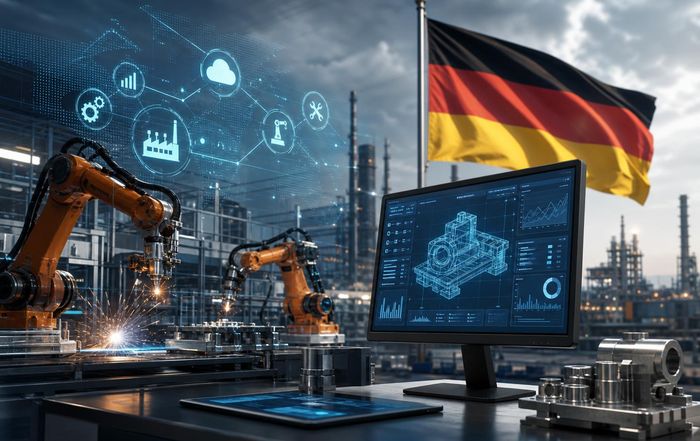
Germany's Industrial Software Market Faces a New Test
Germany's industrial software ecosystem, long a backbone of its manufacturing strength, is entering a period of unusually acute pressure. A convergence of cyclical and structural challenges-slowing global demand, higher capital costs, geopolitical fragmentation, and an accelerating shift toward AI-native and cloud-first architectures-is forcing German vendors and industrial users to rethink decades-old assumptions about how factories are designed, run, and upgraded. The outcome will help determine whether Germany can maintain its edge in high-value manufacturing or risks ceding ground to faster-moving competitors in the United States and Asia.
This article examines what is changing in Germany's industrial software market, why the current test is different from previous cycles, and how key players-software vendors, industrial giants, and mid-sized "Mittelstand" firms-are responding.
From strength to stress: a market at an inflection point
Germany has historically been one of the world's most important markets for industrial software, spanning product lifecycle management (PLM), computer-aided design and manufacturing (CAD/CAM), manufacturing execution systems (MES), supervisory control and data acquisition (SCADA), and industrial IoT platforms. Global leaders such as Siemens, SAP, and Dassault Systèmes (via strong presence in German industry) have long supplied digital tools to sectors like automotive, machinery, chemicals, and electrical equipment. These tools underpin Germany's export-oriented model by enabling high-precision engineering, complex product customization, and efficient mass production.
The last decade's "Industrie 4.0" agenda, promoted by the German government and industry associations such as Bitkom and VDMA, pushed manufacturers toward connected machines, sensor data, and cyber-physical systems. This helped catalyze investment in automation and software, and positioned Germany as a reference market for advanced industrial digitalization. At the same time, the rise of cloud hyperscalers like Microsoft, Amazon Web Services, and Google Cloud introduced new competition and collaboration patterns, as industrial firms began to mix traditional on-premise control systems with cloud analytics and AI.
Since 2022, however, several pressures have converged. The energy shock following Russia's invasion of Ukraine, weakening global demand for capital goods, and higher interest rates have weighed on investment. According to the International Monetary Fund and OECD, Germany's growth has lagged many peers, and business confidence surveys show manufacturers becoming more cautious about large, multi-year IT projects. That does not mean software spending is collapsing-digitalization remains a strategic priority-but it is being scrutinized more tightly, shifted to subscription models, or redirected to projects promising faster payback, such as predictive maintenance and energy optimization.
For people tracking broader macro trends, these developments intersect closely with themes in business, economy, and markets coverage, where capital expenditure cycles and technology adoption are increasingly intertwined.
Cloud, AI, and the challenge to "brownfield" Germany
One of the most distinctive features of German industry is its vast base of "brownfield" plants: long-lived factories, refineries, and mills that combine legacy programmable logic controllers (PLCs), bespoke MES solutions, and proprietary interfaces. This has historically favored established automation and software providers, which could integrate with older equipment and offer long-term support contracts. Today, that same installed base is becoming a constraint as cloud-native and AI-centric approaches gain traction.
Cloud providers such as Microsoft, Amazon, and Google are expanding their industrial offerings, from digital twins and time-series databases to generative AI copilots for engineers and maintenance staff. Meanwhile, industrial software specialists like Siemens and Schneider Electric are pushing their own cloud-based platforms and app ecosystems, often in partnership with those hyperscalers. German manufacturers are being encouraged to move more workloads-from simulation to production planning and condition monitoring-off-premise.
However, the path is not straightforward. Many German firms, particularly in the Mittelstand, remain wary of moving core operational systems to the public cloud, citing data sovereignty, cybersecurity, and dependency concerns. The German Federal Office for Information Security (BSI) and the European Commission have been tightening regulatory frameworks around data protection and critical infrastructure, which adds complexity to cloud migration. Initiatives like Gaia-X, a European data infrastructure project, reflect efforts to retain strategic control over industrial data while still benefiting from modern architectures.
This creates a dual challenge for the German industrial software market. On one side, global cloud and AI players are raising expectations about usability, scalability, and innovation speed, especially for analytics and decision support. On the other, local vendors must help customers modernize without disrupting highly reliable, safety-critical operations. Bridging this gap-often through hybrid architectures combining on-premise control with cloud-based analytics-is becoming a decisive competitive factor.
For readers following AI's impact across sectors, related developments are covered in more depth in our AI and technology sections.
Economic headwinds and investment priorities
Macroeconomic headwinds are adding a sharper edge to these technology shifts. Germany's manufacturing sector has been grappling with weaker export demand, particularly from China; higher energy prices compared with pre-crisis levels; and uncertainty around the green transition's regulatory path. Surveys by institutions such as ifo Institute and ZEW indicate that while digitalization remains high on corporate agendas, boards are increasingly demanding measurable returns on industrial software projects within shorter timeframes.
This is pushing industrial users to re-prioritize projects. Instead of large, multi-year "big bang" transformations of entire MES or PLM landscapes, many companies are opting for modular upgrades, pilots, and targeted deployments that address specific pain points. Examples include deploying AI-based quality inspection in a single production line, adding energy-monitoring software to high-consumption processes, or integrating supplier data into existing PLM systems to improve sustainability reporting. Vendors that can deliver such incremental value, while keeping options open for later scaling, are seeing more traction.
The financing environment is also changing. Higher interest rates and tighter credit conditions make it harder for capital-intensive manufacturers to fund sprawling IT programs. In response, software providers are expanding subscription and "as-a-service" models, sometimes bundling hardware, connectivity, and analytics into operating-expenditure contracts. This can lower upfront barriers but may raise long-term lock-in and cost transparency questions, which German corporate finance teams scrutinize carefully.
These dynamics tie into broader questions about corporate investment and employment, topics we regularly explore in jobs and funding coverage, especially as digital skills and capital allocation decisions converge.
Competition: global giants, Mittelstand specialists, and new entrants
Germany's industrial software market is not a closed ecosystem. It is increasingly contested by global technology firms, specialized niche vendors, and start-ups that see opportunities in analytics, AI, and domain-specific applications.
On the established side, SAP remains central in enterprise resource planning and supply chain management for German manufacturers, while Siemens Digital Industries Software, Dassault Systèmes, PTC, and Hexagon compete across PLM, CAD, MES, and simulation. Automation players such as Siemens, Bosch Rexroth, and Phoenix Contact integrate software closely with hardware, offering end-to-end automation stacks that are deeply embedded in German plants. These companies are increasingly positioning themselves as software and data platforms rather than pure equipment suppliers.
At the same time, global IT and cloud providers, including IBM, Oracle, and Accenture, are growing their industrial digital practices, often acting as systems integrators and transformation partners. They bring horizontal capabilities in cloud migration, cybersecurity, and AI engineering, but must adapt to Germany's specific regulatory and industrial context.
Adding another layer, a wave of start-ups and scale-ups-many spun out of technical universities like RWTH Aachen or TU Munich-is targeting specialized use cases such as predictive maintenance, computer vision for defect detection, or low-code tools for shop-floor apps. Venture and growth investors, including both local funds and international players, have been active in these niches, though the broader European funding slowdown has made later-stage financing more selective.
This competitive intensity pressures incumbents on several fronts: pricing, innovation speed, and openness. Manufacturers increasingly expect interoperability and open APIs, rather than proprietary ecosystems that lock them into a single vendor. European initiatives such as IDSA (International Data Spaces Association) and industry-specific data spaces under the EU's data strategy are reinforcing expectations around data portability and vendor-neutral architectures.
Readers interested in how these competitive dynamics play out globally can find broader context in our global and news sections, where industrial technology competition is a recurring theme.
Regulation, sovereignty, and the politics of industrial data
Regulation and politics are adding complexity to Germany's industrial software choices. Industrial data-ranging from machine telemetry to product usage information-is increasingly seen as a strategic asset. The European Union's Data Act and related initiatives aim to clarify who can access and monetize such data, especially when it is generated by connected products and machines. This has direct implications for German industrial software vendors, which often collect, store, and analyze data on behalf of manufacturers.
German policymakers and industry groups have expressed concerns about excessive dependence on non-European cloud and platform providers for critical industrial data. Projects like Gaia-X and sector-specific data spaces in manufacturing and mobility are attempts to build federated, interoperable infrastructures where data can be shared under common rules without centralizing it in a single platform. While these initiatives have been slower to materialize at scale than early rhetoric suggested, they are influencing procurement decisions and vendor roadmaps.
Cybersecurity regulation is also tightening. The NIS2 Directive and German national rules require higher security standards for operators of essential services, including many industrial firms. This affects software procurement, as manufacturers demand stronger guarantees around secure development, patch management, and incident response. Vendors that can demonstrate compliance and provide transparent security practices may gain an edge, but they also face higher costs and potential liability.
Environmental regulation is another driver. The EU's Corporate Sustainability Reporting Directive (CSRD) and upcoming product-level requirements under the Green Deal are pushing German manufacturers to collect and report more granular data on emissions, resource use, and product lifecycle impacts. This creates demand for new software modules and integrations that can aggregate data from production systems, supply chains, and product usage. It also opens opportunities for sustainability-focused industrial software, an area we explore regularly in our sustainable coverage.
Skills, culture, and the human factor
Beyond technology and regulation, the human side of Germany's industrial software test is becoming more visible. German manufacturers face well-documented skills shortages, particularly in software engineering, data science, and cybersecurity. At the same time, many shop-floor operators and engineers are nearing retirement, taking with them decades of tacit process knowledge that is hard to codify.
Industrial software vendors are responding by investing in user experience, low-code/no-code tools, and integrated training. The goal is to enable domain experts-process engineers, maintenance technicians, quality managers-to configure and extend software without needing full-time developers. However, this shift requires cultural change in organizations that have traditionally separated IT from operations and where decision-making can be cautious and hierarchical.
Unions and works councils, which play a significant role in German industrial relations, are also part of the conversation. They are closely watching how digitalization and AI affect job roles, workload, and training. In many cases, agreements are being negotiated to ensure that new software deployments come with reskilling commitments and clear rules about data use for performance monitoring. This can slow down implementation but may also lead to more sustainable adoption if employees perceive benefits rather than threats.
For labor market and workplace implications of digitalization beyond industrial software, our jobs and business sections provide ongoing analysis.
Strategic responses: how vendors and manufacturers are adapting
Faced with this complex environment, German industrial software stakeholders are pursuing several strategic responses that collectively define the contours of the current "test."
First, many vendors are doubling down on verticalization and domain expertise. Rather than offering generic analytics platforms, they are building highly specific applications for sectors like automotive powertrain, pharmaceuticals, or process chemicals, often embedding regulatory knowledge and best practices. This plays to Germany's strengths in specialized engineering and helps differentiate against horizontal cloud providers.
Second, there is a clear push toward more open and modular architectures. Vendors are exposing APIs, supporting open standards such as OPC UA and MQTT, and participating in industry consortia to ensure interoperability. Manufacturers, in turn, are increasingly demanding reference architectures that allow them to mix and match components from different suppliers while maintaining a coherent security and data governance model.
Third, partnerships are proliferating. Industrial automation companies are teaming up with cloud providers, AI specialists, and systems integrators to co-develop solutions and share go-to-market channels. These alliances can accelerate innovation but also raise questions about who owns customer relationships and data. German manufacturers are learning to navigate this landscape, often insisting on contractual clarity about data rights and exit options.
Fourth, both vendors and users are experimenting with new business models. Outcome-based contracts-where payment is tied to metrics like energy savings, uptime, or throughput-are gaining attention, though they are complex to structure and require trusted, high-quality data. Subscription models and marketplaces for industrial apps are also expanding, influenced by consumer and enterprise software trends.
Finally, there is a growing emphasis on resilience. The experience of supply chain disruptions, cyber incidents, and geopolitical tensions has made German manufacturers more sensitive to single points of failure in their software and data infrastructure. This is pushing them to consider multi-cloud strategies, on-premise fallbacks for critical control systems, and more rigorous business continuity planning. Industrial software vendors that can demonstrate resilience and support multi-vendor environments may be better placed to win long-term trust.
What to watch next
Whether Germany's industrial software market emerges stronger from this test will depend on how effectively it balances innovation with continuity, openness with sovereignty, and speed with reliability. Several signposts will be worth watching over the next few years.
One is the pace of cloud and AI adoption in core industrial operations, beyond pilots and proofs of concept. If German manufacturers begin to run mission-critical planning, optimization, and quality functions on cloud-based, AI-driven platforms at scale, competitive dynamics could shift quickly toward those vendors best positioned in that stack. Another is the evolution of European regulatory frameworks around data, cybersecurity, and sustainability, which will shape procurement and architecture choices.
The health of the Mittelstand will also be crucial. These mid-sized firms are both major buyers and important suppliers of specialized industrial software and machinery. Their willingness and ability to invest in modern digital tools, despite economic headwinds, will influence the entire ecosystem's trajectory. Finally, talent flows-whether Germany can attract and retain enough software and data experts, while equipping its existing industrial workforce with new skills-will be a decisive factor.
For international investors, technology providers, and industrial leaders, Germany's industrial software market is more than a national story. It is a bellwether for how advanced manufacturing economies adapt their digital foundations under pressure. As the test unfolds, developments in this space will continue to intersect with themes across technology, markets, global, and economy coverage, offering early signals about the future shape of industrial competitiveness worldwide.